In this article
Our honest take on Wirecutter’s refreshed 2026 board game picks.
Wirecutter refreshed its “Best Board Games” roundup on October 7, folding in two picks from its cooperative games guide: Daybreak and Castle Panic. The list opens by insisting there is no best board game for most people, then spends the next few thousand words handing you a category-by-category set of answers anyway. Fair enough. That is what these lists are for.
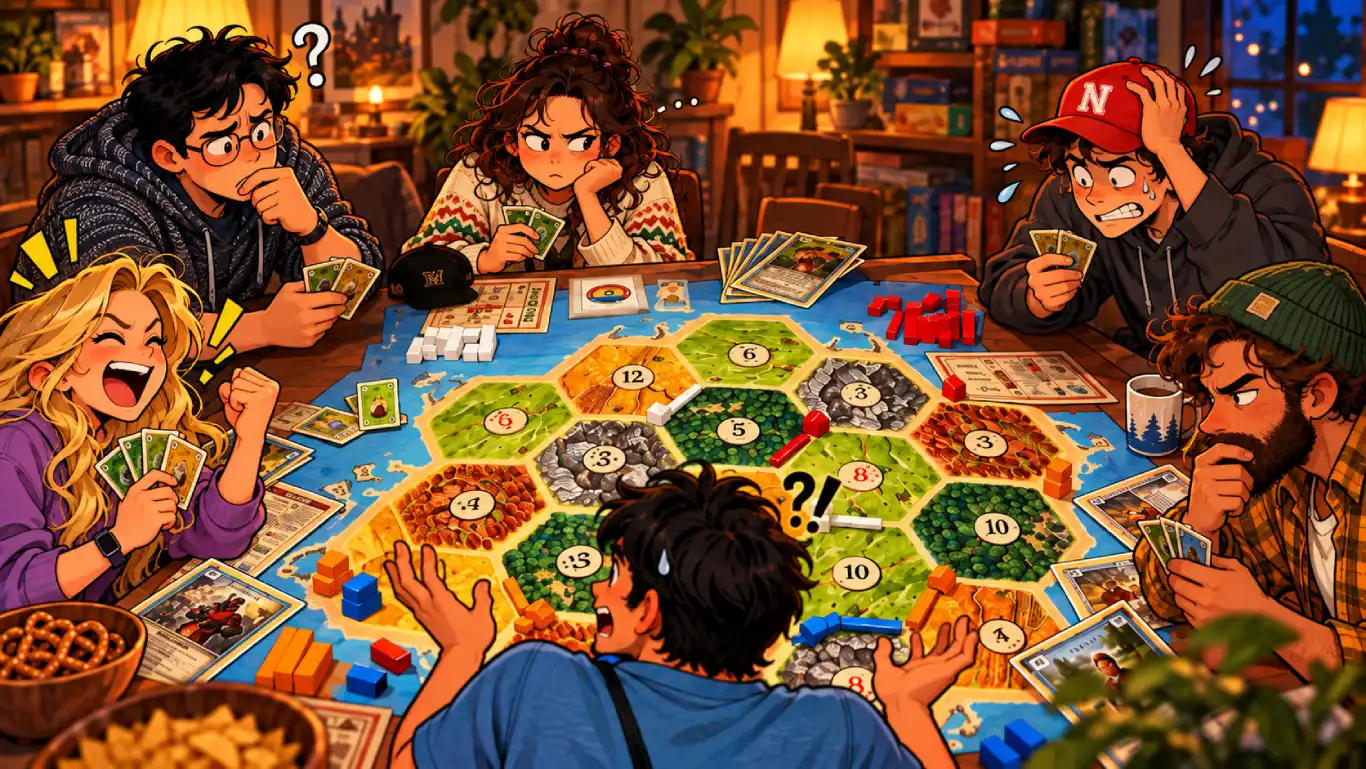
Read the actual picks, though, and a pattern shows up that nobody at the table asked about out loud. This is a list built to keep the peace. The clearest tell is how 7 Wonders gets recommended specifically because your neighbors cannot refuse a trade, unlike a certain other game. Catan itself appears only as the cautionary example, the one where trading gets heated.
The cooperative section grew this cycle, and Daybreak earns its spot partly for a design that kills off “quarterbacking,” where one know-it-all runs everyone else’s turns. Wingspan, one of the best-selling games of the last decade, is nowhere on it.
None of that makes the list wrong. It makes it conservative, and conservative is a defensible setting for a guide aimed at people who have never bought a hobby game before. Here is where I land on every pick.
Where the List Plays It Safe, and It’s Right
The strategy picks are the two I would have led with myself. Brass: Birmingham is the game sitting at the top of most serious rankings for a reason, a production-and-logistics knot that rewards the kind of player who enjoys being slightly stressed for two hours.
Root is the harder sell, and the guide is upfront about it, an asymmetric war game where teaching four factions feels like teaching four games, with a payoff that only arrives once everyone clears that wall. Both belong in any real conversation about strategy board games, and neither is a safe family-night purchase.
Hive is the quiet standout among their two-player entries, chess depth with none of the chess baggage, and it travels in a bag with no board to set up. 7 Wonders deserves the beginner slot it gets, since drafting is a mechanic every new player should meet early and the rounds genuinely end on time.
Splendor I am softer on than they are. It teaches engine-building cleanly, but it is nearly solitaire in practice, four people optimizing in parallel with barely a reason to look up. A fine first game. Not one I reach for twice in a night.
The Lighter Picks That Earn Their Spot
Cat in the Box is the sharpest inclusion on the whole list. Taking trick-taking, the oldest card format there is, and bolting on a declare-your-suit-as-you-play twist is the rare modern idea that improves a classic instead of decorating it. Skull sitting next to it is the right call too, the purest bluffing game in print and the easiest to teach a skeptical group in under a minute.
Star Realms remains the deck-builder I hand people who think they do not like deck-builders, quick and vicious and cheap.
A Fake Artist Goes to New York and Wavelength are both strong party choices, though I would flag what the guide soft-pedals: both live or die on the group. Fake Artist with a quiet table is a long silence, and Wavelength with people who refuse to argue about where spaghetti lands on a wet-to-dry scale is just a dial nobody turns.
The Co-op Additions Are the Actual News
The two new entries are the reason to read this update at all, and they tell you where mainstream taste is heading. Daybreak is a climate-crisis co-op that spreads decisions across everyone’s personal board, which is a real structural fix for the problem of one loud player hijacking a cooperative game.
Castle Panic is the lightweight counterweight, a tower-defense game simple enough to teach in ten minutes and luck-driven enough to sting when the cards dry up. Adding both signals the same thing as the rest of the list: the hobby’s center of gravity is drifting toward games where the table works together instead of knifing each other.
For Kids and for Playing Alone
Boop is a genuinely clever pick for the family slot, a cats-on-a-bed abstract that hides real two-player tension under an aesthetic built to disarm. Sushi Go earns its spot on speed and accessibility, the pick-and-pass format young kids grasp before they can read the scoring. Both are stronger than the category usually gets.
The solo picks are where the list stops being for beginners at all. Final Girl is a tense, gorgeous slasher simulator that their own testers admit overwhelmed casual players, which is an honest thing to print and also a quiet warning. Legacy of Yu is the gentler entry point, a self-balancing campaign that adjusts to how badly you are losing, which is exactly the hand-holding Final Girl refuses to offer.
Wingspan does not appear at all. Catan shows up only as the game where trading gets heated.
The Outliers, Outside and in the Mail
Ladder toss is the backyard entry, and it is fine, bolas and a target with the physics doing the heavy lifting. Lacuna is the one I would actually pack, a two-minute-setup area-control game with premium pieces and a rollable mat, built for a picnic blanket.
The Mysterious Package Company box closes things out as the splurge, a mailed Victorian murder mystery with physical clues to open. Lovely, pricey, and a one-time experience rather than a game you own, which is worth knowing before the fifty dollars leaves your account.
So: a good list, honestly argued, and quietly allergic to conflict. If that describes your table, buy almost anything on it. If your group actually enjoys the knife-fight of a tense trade or a well-timed betrayal, notice what is missing before you take the whole thing as gospel.