

The gateway problem
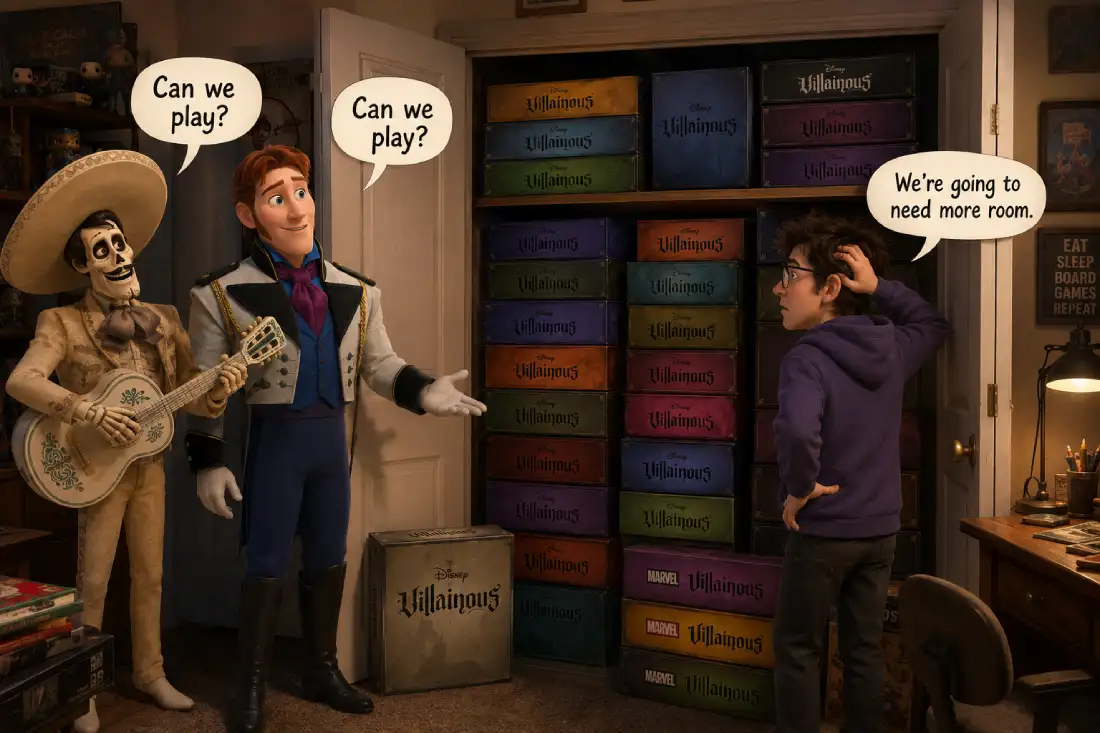
The best strategy board games for adults who are newer to the format tend to share a specific quality: the rules are learnable in one sitting, but the decisions don't feel trivial. That's a narrow window. Too simple and there's nothing to think about. Too complex and the game becomes homework before it becomes fun. If you're not sure where your group sits on that spectrum, the family games category covers the lighter end and makes a reasonable starting point before stepping up. Disney Villainous sits in that window in an unexpected way. On the surface it reads as a family game, and it works at that level, but the underlying design is genuinely strategic. Each villain operates as a separate puzzle with asymmetric rules and a distinct win condition, which means understanding your own character deeply enough to execute a plan while disrupting everyone else's is the actual game. That's a strategic skill set, dressed in accessible theming. For someone who wants real decisions without committing to a 200-page rulebook, it's a more honest entry point than most games marketed as strategy titles. The gateway question is worth taking seriously because the wrong first strategy game does real damage. A new player who bounces off something too heavy too early tends to write off the entire category rather than just that game. Starting with something that delivers genuine strategic decisions inside a manageable rules footprint is how the category builds its audience.What strategy board games actually reward
The category covers a wide range. At one end you have games built almost entirely around resource management and long-term planning. At the other you have games where tactical decisions in the moment matter more than any overarching strategy. Most of the best strategy board games live somewhere in the middle, requiring both. What they share is that losing feels instructive rather than arbitrary. In a well-designed strategy game you can usually trace the loss back to a specific decision, which is either satisfying or maddening depending on your temperament. That feedback loop is what makes strategy games for adults genuinely replayable in a way that luck-heavy games aren't. You're not just playing again; you're testing a hypothesis about what you'd do differently. There's also a social dimension to strategy gaming that doesn't get talked about enough. The best strategy board games create a shared language between the people who've played them. References to past games, running jokes about a particular blunder, the quiet satisfaction of watching someone fall into the same trap twice. That accumulation of shared history is part of what makes the category stick with people long after individual sessions are forgotten.Hard board games vs. complex board games
These aren't the same thing and the distinction is worth making. A hard board game is one where the decisions are genuinely difficult, where the optimal path isn't obvious even to experienced players. A complex board game is one with a lot of interlocking rules and systems, which may or may not produce difficult decisions once you've learned them. The most rewarding strategy board games tend to be hard without being needlessly complex. The rules exist to create interesting decisions, not to demonstrate that the designers thought about a lot of things. When complexity serves decision-making it's an asset; when it's just overhead, it's a barrier that keeps people from getting to the actual game. That's the lens worth applying when evaluating anything in this category. How quickly can you get to a real decision? And when you get there, does it actually matter? Strategy board games for adults who are coming from lighter games often underestimate how quickly they'll adapt. The jump from a family game to a medium-weight strategy title is smaller than the box art and BGG ratings suggest. The main barrier is usually psychological: the assumption that heavier means harder to enjoy, rather than just harder to learn. Most people who push past that assumption find the category opens up faster than expected. For evenings where you want everyone working toward the same goal rather than competing, cooperative games offer strategic depth in a different format.What to look for in a strategy board game:
- Decisions that feel meaningful from the first session
- Loss states you can learn from rather than blame on luck
- Rules complexity that serves the game rather than obscuring it
- Enough replayability that the fifth game is more interesting than the first
- Scales well to your usual player count without dead time