Loading…
Power Vaccum board game review
Build your statue, brag your victory.
-5.5
(0 reviews)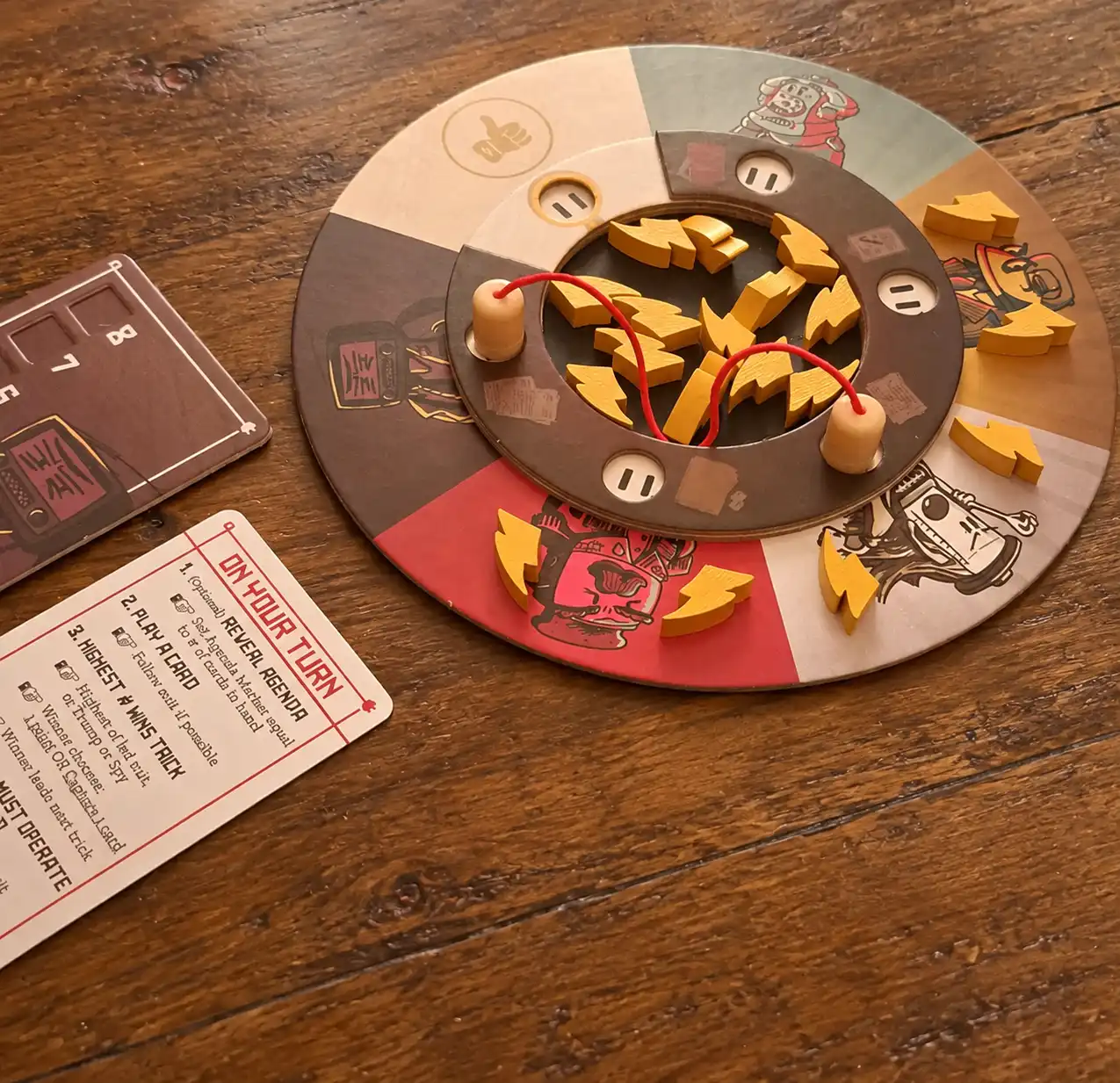
At a glance
- Players
- 1-5
- Play Time
- 45 mins
- Ages
- 8+
✓ What We Love
- •Building the statue gives you something to hold, four chunky pieces stacking into a genuinely funny monument to yourself
- •The satire lands. Anthropomorphic appliances scheming for a dead leader's throne is a dumb premise executed with real style, and the art carries it
- •A round moves. Eight tricks, thirty to forty-five minutes, nobody's checking their phone waiting for a turn
- •The rulebook teaches the game properly, trick-taking basics first, special cases layered on after, rather than dumping every exception on you at once
- •A real solo mode against two scripted bots, not a bolted-on afterthought
✗ Could Be Better
- •Once a player strings together two good plays on the Power Cable, the round is functionally over. There is no mechanism to claw back a lead built that way
- •You're required to show your card backs if another player asks. In theory that's the information layer working as designed. At the table it mostly means holding your hand at an angle and hoping nobody checks
About Power Vaccum board game review
Power Vacuum didn’t come out of an established publisher’s catalog. It funded on Kickstarter in April 2024, asking for $11,500 and closing at more than $145,000 from over 3,100 backers in under a month, the kind of overfunding that usually means a pitch landed with people who’d never heard of the game a week earlier.
Kaleb Wentzel-Fisher built the trick-taking engine underneath it, Malachi Ray Rempen handled the illustration and ran the campaign itself, and the whole thing shipped later that year under their own Keen Bean Studio banner.
Power Vacuum hands you information most trick-taking games would never give up. Every suit is printed on the back of every card, so by the second trick you already know who’s sitting on a fistful of Money and who hasn’t got a single Violence card to their name. It should feel like playing poker with everyone’s hand turned face up. It doesn’t, because the suits on the back are a decoy. The real game sits somewhere else entirely.
Win a trick and you get a clean choice: bank a point, or pocket the card for your next hand. That part is ordinary trick-taking currency. The real prize is for playing the lowest card in the trick, win or lose, because that earns you control of the Power Cable, and the Cable decides who ends the round with the most and least Power, which is exactly what your hidden Agenda is betting on, which is where the points actually live. Seven games in, I can call the outcome before it happens.
Somebody locks in two good plugs early, muscles the board toward the result their Agenda already predicted, and the other three or four players spend the rest of the round watching a decision that’s already been made. There’s no rubber band here, nothing punishing the leader or boosting whoever fell behind. Miss one trick, misjudge one plug, and you’re not catching up. You’re finishing out a game somebody else already won.
Two Good Plugs and It’s Already Over
Ask the people who built this what Power Vacuum is about and they’ll say it plainly: you’re not playing your hand, you’re playing the other people at the table. That’s the right way to think about it, and it’s also the hardest part to teach.
A newer group I heard about ran into the failure mode from the opposite direction: nobody could get a read on the social layer, so every trick turned into a race to play the lowest card and grab the Cable, trick-taking abandoned entirely in favor of board control. Both outcomes point at the same design problem. The visible suits promise a legible game where you can plan around what everyone’s holding.
The Cable quietly overrides all of it, and once you understand that, the visible-hand gimmick starts to feel like a magic trick’s misdirection more than a real strategic layer.
The Statue Is Why You Keep Playing Anyway
None of that stops me from wanting another round, and the reason is mostly physical. Trading in ten points of Power for a plastic piece, then stacking foundation, bottom, torso, and head into your own ugly little monument, is a better scoring track than a pad of paper has any right to compete with.
The art does real work too, five overthrown household appliances plotting a coup with genuine menace in their eyes is a funnier premise than it should be, and it never winks at you hard enough to undercut the game underneath it.
At thirty to forty-five minutes with a full table, or solo against two scripted appliances that are honestly a little vicious about chasing their own Agenda, it doesn’t ask for much of your evening.
It asks a lot of your table’s attention instead, and that’s the trade a three out of five is pricing in: genuinely fun when everyone’s locked in, and a rough sit the moment somebody isn’t.
Anyone building out a shelf of strategy board games that reward reading the room over optimizing a hand should find room for it, with that caveat firmly attached.
📖 Rulebook
How to Play Power Vacuum
Setup
- Place the Control Board in the center of the table. Five sockets sit around its edge, one per Appliance, plus a sixth socket wired to the central Power Supply.
- Each player takes the Appliance board nearest to them. Unclaimed Appliances stay in play, run by no one.
- Each player takes an Agenda marker, placed in the 14/0 starting position on their Appliance board.
- Place two Power tokens beside every Appliance, including unclaimed ones. The rest go in the center as the Power Supply.
- Shuffle the Regime cards and deal eight to each player, kept secret in hand.
- Shuffle the Agenda cards and deal one to each player, kept secret in hand.
- Reveal the top Agenda card. It shows two Appliances, connect them with the Power Cable's two plugs. Set that card aside.
- Arrange the Statue pieces (foundation, bottom, torso, head) in a shared display.
- Set out the large Power tokens and Level markers.
- Whoever most recently got an electric shock goes first. Play proceeds clockwise.
Your Turn
Power Vacuum is a trick-taking game played over rounds of eight tricks each.
- Leading: The starting player plays any card. Its suit is led for that trick.
- Following: Other players must follow the led suit if they can. With no card of that suit, play anything.
- Spies (Brown): Spy cards ignore the must-follow rule entirely and can be played on any trick. If a Spy leads, nobody has to follow suit.
- Winning normally: Highest card of the led suit wins.
- Trumps: Red (Violence) is always trump. Any Red card beats a non-Red, non-Spy card regardless of number.
- Spies vs. trumps: Brown beats Red, but only Red. Against any other suit, a Spy is just a normal card in that trick, unable to win unless it's also the led suit's number leader (it isn't, since Spies don't count as belonging to any suit).
- Winning the trick: The winner chooses to score 1 point, or capture one card from the trick to add to their hand next round.
- The Control Board: Whoever played the lowest-numbered card in the trick, regardless of suit, and regardless of whether they also won it, must manipulate the Control Board: transfer one Power token between the two Appliances currently connected by the Cable, then move one end of the Cable to any open socket.
- Revealing your Agenda: On your turn, before playing a card, you may reveal your Agenda if you still hold at least five cards. Choose which half of the card counts as correct for Most Power and which for Least, then set your Agenda marker to match your current hand size, that number is how many points each correct half is worth. Wait too long (four cards or fewer) and you become a conspirator: your Agenda stays hidden until round's end and only pays out if both halves are correct.
End of Round and Scoring
- Mark which Appliance(s) have the Most and Least Power at the Control Board.
- Collect the Power tokens from your Appliance as points.
- Reveal any still-hidden Agenda and score it.
- Trade every 10 points of Power for a Statue piece, one per level (foundation, bottom, torso, head).
- If nobody's completed a statue, reset Power levels, reshuffle, and start a new round.
Winning
The first player to complete all four Statue pieces wins immediately once the current round ends. Ties go to total points, then to whoever built the better-looking statue.
📖 Rulebook
- Components: 40 Regime cards across four suits (Yellow/Money, White/Media, Green/Bureaucracy, Red/Violence), numbered 1-9; 4 Brown Spy cards disguised as one of the other four suits on their backs; 10 Agenda cards, each naming two Appliances; a Control Board with attached Power Cable; 5 Appliance boards and markers; Power tokens (40 small, 5 large); 20 Statue pieces across four types; a solo mode aid.
- Card backs are public: suits are visible to all players on the back of every card and must be shown if another player asks. Spies are the exception, their backs show a disguise suit, not Brown.
- Ties are friendly: if more than one Appliance shares Most or Least Power, they all receive the marker. If every Appliance ties, all score both halves of a correct Agenda.
- Conspirator scoring is all-or-nothing: an Agenda revealed only at round's end pays 14 points if both halves are correct, or zero if only one is.
- Agenda payout scales with hand size at reveal: revealing at 8, 7, 6, or 5 cards in hand scores that many points per correct half (doubled if both halves are correct).
- Statue pieces are drawn one at a time in turn order starting with whoever won the last trick of the round, unless the table agrees to a free-for-all.
- Solo mode pits you against two scripted Party Apparatuses on a fixed logic (lead and follow with the leftmost matching card, transfer Power toward their own Agenda first, then against yours), with a difficulty table adjusting starting hand sizes.