In this article
Monster Couch’s cozy dragon board game goes digital.
The dragons are adorable. The strategy runs shallower than the studio’s last game.
Monster Couch built the Wingspan video game, which is the digital board game I have sunk the most hours into by a wide margin, so I came to their Flamecraft adaptation already knowing what this team does to a tabletop game when they get their hands on it.
They rebuild it as a tiny, animated, hand-painted world rather than a flat menu of cards, and they score it like a lullaby. Flamecraft, the digital version now out on Steam, PS5, Xbox, and Switch, gets all of that treatment. What it does not get, because the box never had it to begin with, is much depth once you have seen the town a few times.
That is the honest shape of this one. It is the coziest game I have booted up in months, and it is also the one my group is most likely to solve.
What Monster Couch’s Digital Version Gets Right
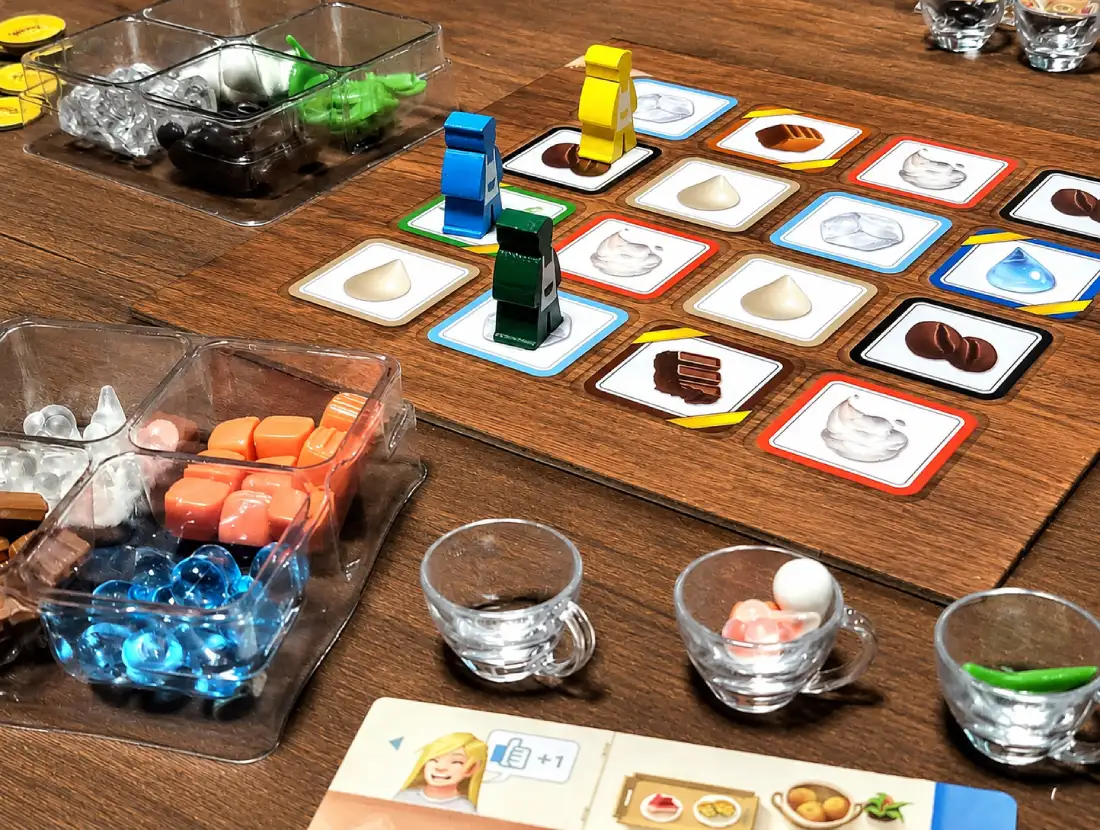
The town is the star. Every shop is a little 3D diorama, the dragons have more personality than they have any business having at this size, and the soundtrack is the sort of thing you leave running after you have stopped playing. If you liked how the Wingspan app felt to sit inside, this feels the same way, warm and unhurried, built by people who clearly like the source material instead of just licensing it.
It plays fast, too. A full game lands around the hour mark, which makes it the thing you put on when a heavier game has collapsed because someone at the table fell asleep three quarters of the way through Caverna. Cross-play carries across PC, consoles, and Switch, so a group split across devices can still share a table. That flexibility is real, and it is the sort of thing the physical box simply cannot offer.
The rules teach themselves. You draw dragon cards, you place them on the town’s shops, and each dragon and shop hands you an action when you do: draw more dragons, collect goods, cash goods in for the reputation points that decide the winner. A handful of short tutorials and one full game is enough to have the whole loop down. Mastering it takes longer, but nobody is going to bounce off the on-ramp.
There’s a Free Demo, So You Can Actually Try It First
Here is the part the marketing buries and the part I care about most: there is a free demo on every platform, Steam included. It hands you a slice of the town, a few dragons, bot opponents, and local multiplayer for up to five, which is more than enough to know within one sitting whether the game clicks for you.
That matters because Flamecraft is a buy, not a rental, and the demo turns a blind purchase into an informed one. If you have been circling the physical box at forty-odd dollars, an hour with the free digital version tells you whether the cozy dragon shopkeeping loop is your thing before you commit to cardboard. This is the same logic behind trying any board game on a screen before buying it, which I got into at more length when Amazon Luna put King of Tokyo up for free. If that is the way you like to shop for games, the piece on the board games you can try digitally before buying is worth a read alongside this one.
Six Dragons, Six Actions, and Where the Ceiling Shows
Now the catch, and it is a structural one, not a porting complaint. Flamecraft runs on six dragon types tied to six goods: bread, meat, iron, crystal, plant, and potion. Every dragon of a color does the same thing every other dragon of that color does. That is elegant, and it is also a hard limit on how many genuinely different turns the game can hand you.
Compare it to the studio’s own Wingspan, where the deck runs into the hundreds of birds and nearly every one carries its own power, so the range of what you might do on a turn is effectively bottomless. Flamecraft is not trying to be that. It is a lighter, breezier thing, a gateway toward the Agricola and Caverna end of the hobby rather than a resident of it. But you feel the smaller menu.
My group will get good at this and then, I suspect, get to the bottom of it, because there are only so many optimal lines when everyone is drawing from the same six-action pool. The trip to that point will be pleasant. It will also be finite in a way Wingspan never was.
The AI Coasts, and There’s Still No Phone Version
Two smaller marks against it, both carried over faithfully from what this studio ships.
The bot opponents come in three difficulty levels and none of them will scare you. Same story as the Wingspan AI: fine as a warm body when you cannot get a group together, never a real threat once you understand the game. There is a solo story mode too, though if you are here for multiplayer the way I am, you will barely touch it.
And there is no mobile version. The whole thing is cross-play across PC, TV consoles, and Switch, which is genuinely convenient, but the absence of a phone build makes it less grab-anywhere than the Wingspan app, which lives in your pocket. For a game this light and this quick, phone is exactly where a lot of people would want it. That gap will probably close, but it is open right now, and it is the one omission that stings.
Is the Flamecraft Video Game Worth Buying?
Yes, with your eyes open. Monster Couch has made the prettiest, warmest version of Flamecraft that could exist, and if you want a cozy hour that asks little and gives back a lot of charm, this is an easy recommendation. Just know going in that the ceiling is lower than the studio’s last adaptation, the AI is scenery rather than a rival, and it is not on your phone yet. Play the free demo first. It is the whole review, compressed into one sitting, and it costs you nothing but an evening.