Loading…
Coffee Rush
Order up, wait, here come 5 more.
3.4
(0 reviews)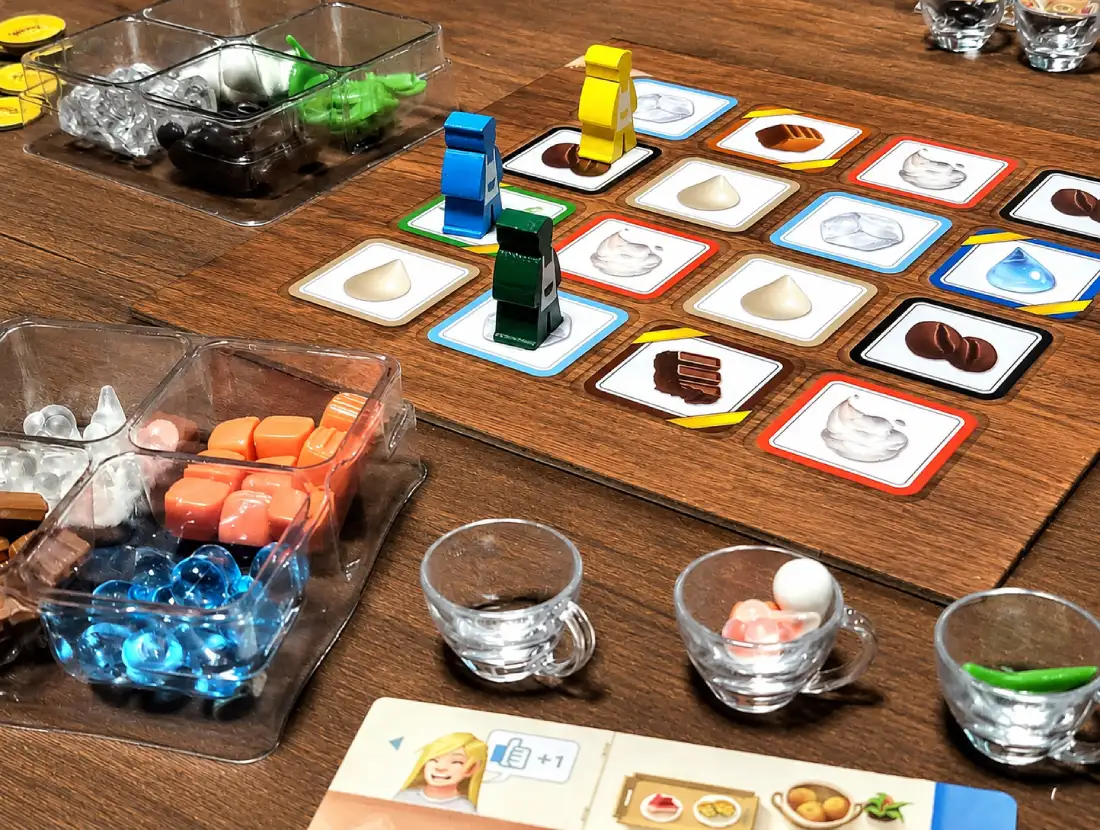
At a glance
- Players
- 2-4
- Play Time
- 30 min
- Ages
- +8
✓ What We Love
- •Lovely set up, tiny ingredients, coffee mugs, what's not to love?
- •Easy to travel with
- •Very simple game to learn
- •High degree of playability
✗ Could Be Better
- •The game pieces can get lost easily
- •Easy to get frustrated
- •Can be too random for some players
- •The rulebook is difficult to understand sometimes
- •If the rules aren't explained correctly, it can get easy to cheat.
About Coffee Rush
About Coffee Rush
I’ve served an absurd number of imaginary lattes for this, so here’s the verdict up front, before you wade through a dozen more reviews: this is one of the prettiest games I’ve put on a table this year, it’s lighter than the box suggests, and a lot of the people calling it broken are skipping a rule. All three are true at once, which is what makes it worth a proper review to figure out if this game from Korea is fun or not.
How to Play Coffee Rush in Sixty Seconds
You’re a barista working a busy street. Each round you move your meeple one to three cells around an ingredient board, and every cell you step onto hands you whatever’s printed there — think Catan, except nobody’s trading wool for ore and the sheep have been replaced by milk, caramel or ice.
You pour those ingredients into your 3 containers, and once one matches an order parked on your player board, you fulfill the client’s drink choice and bank it. If you are thinking, “Oh, that sounds so simple,” hang on to your cappuccino; it’s going to get rough.
Completed orders raise your rating; letting them rot becomes a penalty that pulls it back down. Spend 3 of them and you can buy an upgrade that speeds up gathering (believe me, you are going to need it).
The game ends when the order deck empties or someone hits their fifth penalty, and the highest rating wins. It teaches in five minutes, and watching the cups fill with chocolate and steam and ice is honestly just fun to watch. The trap is assuming the game stays as gentle as that sounds.
And I know you must be asking yourself, is this a great game to enjoy while drinking a coffee? After failing four times, you might consider opening a bottle of wine instead.
Why It Feels Too Easy at 2 Players (and the Rule Everyone Skips)
This is the single most useful thing in the review, and it’s buried inside nearly every “this game has no tension” complaint online. Scroll through enough reviews and threads and you’ll find the same complaint, word for word, from a dozen different accounts. They’re skipping a rule, and it’s specifically a two-player rule.
In the two-player game, at the end of every turn you slide everything down a tab and add a fresh drink to your top slot. That refill is the pressure system. Skip it and they never pile up, you clear everything at a stroll, and you sit there waiting for a difficulty spike that never arrives.
That’s exactly what hit the players who worked through the entire deck wondering when it would bite, until one of them realized they hadn’t been feeding that slot every round. Several others commented in boards like Reddit that they fell on the same trap, committing that identical mistake.
So the most common knock on this game is, more often than not, one missed line in the two-player rules. Feed that slot every turn the way you’re meant to, and the board floods faster than you can serve. The real game only shows up when you play it right.
Coffee Rush Strategy: Where the Real Pressure Comes From
At three and four players, the refill becomes somebody else’s job, and this is the cleverest thing in the design. Whenever you finish one of your orders, the two neighbors to your left must draw that many fresh orders onto their boards. Being productive isn’t just good for you. It actively buries your neighbors.
The pressure in a full game is emergent; you see it with every movement: it flows from everyone else succeeding, so the better the table plays, the harder the table gets. That escalation is what makes a full table so much fun once everyone’s stack is threatening to spill over. Two-player has to fake that with the manual refill, which is precisely why skipping it hollows the whole thing out.
You start getting jealous of the other players’ orders, why do you get stuck with the brutal one while your friend just needs two? Well, blame it on the customers. They are imaginary, it’s OK.
Winning is a rating race, but a stingy one, and penalties are where it’s decided. Every customer’s wish that ages off your board before you clear it costs you. The practical wisdom holds up: finish about two coffees a round and decide in advance which one you’re sacrificing, because you will not save them all. Good play here isn’t maximal. It’s triage.
Coffee Rush Rush Tokens: Why Failing an Order Pays
The ingredient board has one constraint that drives everything: you can pass straight through a cell holding another barista’s wooden figurine, but you can’t end your round there.
That coveted little coin buys extra steps, which is why good players cling to at least one, purely to slip off an occupied cell and still finish the route they planned — the kind of spatial thinking that puts this game closer to strategy games than its theme lets on.
Here’s the wrinkle that tells you the designer knew exactly what they were building. When a drink ages off, it becomes a penalty, yes, but it also hands you that same coveted coin as consolation. Failure comes partly refunded. So the obvious instinct, never miss one, is sometimes the wrong play, and you’ll occasionally let a customer walk on purpose because the coin outvalues the sale. A weaker game would call that a leak. This one makes it one of the sharper decisions on the table.
Scoring: Why Your Final Total Stays So Low
Now the part that decides it for most people. The ratings are deliberately small: a fulfilled one is worth a single point, an upgrade tile two, a penalty minus one.
Run the math and a hard-fought game lands somewhere around five or six. People regularly flag it, all that scrambling for a single-digit total. You can argue the scale is arbitrary, that multiplying every value by ten would change nothing, and on paper you’d be right. At the table it still feels flat. For a game built on a frantic waiter’s nightmare, the climax is oddly hushed. Reviews that dock it a point for the low final score are missing what that number is actually doing — it’s measuring tension, not point salad.
The game is beautiful. The components carry it. The tiny mugs, the ingredient bits, the insert that makes setup painless, all lovely, and it is a great game to have in your lineup.
Is It Worth It? Who Should Actually Buy It
Run a board game cafe, shopping for a coffee-obsessed parent, or want a family game night pick your eight-year-old can actually win? Easy yes. It’s built for two to four players, ages eight and up, and it’s exactly the kind of fun, low-stakes family game that survives a mixed-experience table.
It’s a beautiful object wrapped around a small, sharp game, and whether that’s worth the money to your family’s game shelf comes down to which of the two you came for. Designed by Euijin Han, published by Korea Boardgames and distributed by Asmodee. Lovely, light, and far tenser than its reputation, right up until someone forgets to refill that slot — pull it out for family game night and you’ll see exactly what I mean. Between the glowing reviews and the frustrated ones online, the truth sits closer to the glowing side.
📖 Rulebook
1. 📖 Rulebook
- Place the Ingredient Board in the middle of the table.
- Put all Ingredients and Rush Tokens beside the board as the Supply Area, then shuffle the 80 Beverage Cards into a face-down deck next to it.
- Each player takes 1 Player Board, 1 Meeple, 4 Upgrade Tiles (placed face-down on its upgrade spots), and 3 Cups (set above it).
- Choose a starting player and give them the Starting Player Token, "OPEN" side up.
- Deal starting orders: the starting player places 2 Token Cards on tab 1 and 1 on tab 2; every other player places 1 on each.
- Going anticlockwise from the starting player's right, alternate placing your Meeple on an empty board cell (no sharing a cell). Then each player takes whatever's underneath into a Cup.
- Activate Upgrades (optional). If you have 3 or more fulfilled Beverage Cards, discard 3 of them to flip one Upgrade Tile face-up. It stays active for the rest of the game.
- Move. Move your Meeple 1 to 3 cells, up/down/left/right, and take the ingredient of every square you "step" on. You may pass through a cell holding another figurine but cannot end your move there.
- Pour Ingredients. Distribute what you gathered into your cute containers, or return unwanted ones to the Supply. Once it lands in a container, it's stuck there — it can't be moved to another container.
- Process Order. If one of those beautiful containers exactly matches the Card, you've fulfilled it: return the contents to the Supply and tuck it behind the top-left of your board.
- That's it. Slide everything remaining down one tab. Any order pushed off the last one expires into a penalty.
- Double Meeples: take 2 ingredients from an occupied cell.
- Diagonal Movement: you may move diagonally.
- Double Corners: take 2 from the 4 corner cells.
- Double Specialties: take 2 from caramel, chocolate, water, and tea-leaf cells.
- Completed Order: +1 each
- Activated Upgrade Tile: +2 each
- Penalty: −1 each