Party board games live or die by one thing: the room. A game that works brilliantly with six close friends who like to argue will fall completely flat with ten coworkers who just met at a company retreat. That's not a flaw in the game; it's the nature of the format. More than any other category, party games are social tools first and games second, and the best ones are designed with that priority clearly in mind.
What that means in practice is that the rules have to disappear. Nobody at a party wants to spend twenty minutes learning how to play something. The best party board games get everyone moving within five minutes, and the game itself fades into the background while the people at the table become the entertainment.
That's a harder design target than it looks. A game with too many rules kills the momentum before it starts. A game with too few gives people nothing to push against. The sweet spot is a tight, simple structure that creates just enough constraint to generate interesting decisions, then gets out of the way.
The large group problem
Most board games stop scaling well above five or six players. Party games for large groups have a different design challenge entirely: keep everyone engaged even when it isn't their turn, prevent any single player from dominating the experience, and make sure the chaos of ten people in a room is an asset rather than a liability.
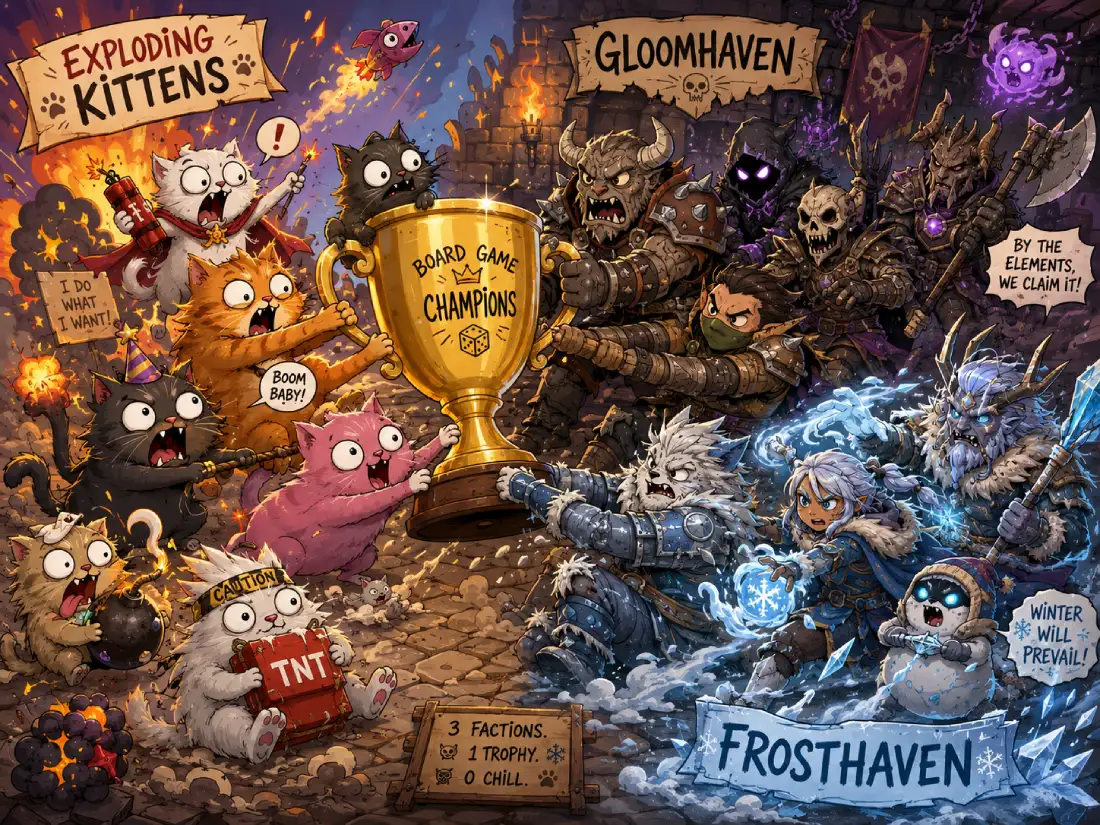
The games that solve this tend to use simultaneous play, team structures, or audience-participation mechanics that keep the people not actively taking a turn invested in what's happening. Exploding Kittens handles it through sheer speed and table talk: turns are short, the threat of elimination is always present, and watching someone else panic their way through a bad draw is genuinely entertaining even when you're not the one playing it. It's one of the more reliable fun party games precisely because the spectator experience is almost as good as the playing experience.
That's not easy to engineer. Most games that try to solve the large group problem end up creating dead time for half the table instead.
Party games for adults vs. everything else
There's a real difference between party games for adults and games that just happen to be played at parties. Adult party games tend to lean on social dynamics, hidden information, or humor that requires a shared frame of reference. They work because the players bring the content; the game just provides the structure.
The best party card games operate this way. The deck is almost irrelevant compared to the people holding the cards. Exploding Kittens works as well as it does partly because the negotiation, bluffing, and betrayal that happen around the mechanics are entirely player-driven. The game creates the conditions; the adults at the table create the actual experience. Strip out the social layer and there isn't much left, which is exactly the point. The game is a catalyst, not the thing itself.
That's also why these games tend to scale with the group rather than against it. A louder, more opinionated table doesn't break a well-designed adult party game. It improves it. The worst thing that can happen to a party game is a quiet, polite group that plays it exactly as written.
When the game needs to work for everyone
Not every party is adults only. Best party board games for mixed groups need a different kind of design: accessible enough that a twelve-year-old isn't lost, but not so simplified that the adults are bored by round two. That's a narrower target than it sounds, and most games miss it in one direction or the other. If the group skews younger, the kids games category is the more honest starting point.
The ones that land tend to use physical or visual mechanics rather than wordplay or cultural references, which age poorly and exclude younger players. Speed-based games, pattern recognition, and anything with a tactile element tend to cross the age gap better than trivia or bluffing games that rely on shared context.
What separates good party games from forgettable ones
The real test isn't whether people enjoy the game the first time. Almost any party game gets a decent first session on novelty alone. The test is whether someone suggests it again three months later, or whether it gets requested at the next gathering. Fun party games that pass that test tend to have one thing in common: the stories they generate. A game session that produces a moment people reference later has done its job. A game that ends and is immediately forgotten hasn't, regardless of how smoothly it played.
For evenings that call for something more focused and head-to-head, the two-player games category is worth a look.
What to look for in a party board game:
Teaches in under five minutes with no prior experience
Scales to at least six players without dead time
Produces moments people talk about after the game ends
Works across a range of energy levels and group dynamics
Short enough to play twice in one sitting if the group wants to