Loading…
Secret Hitler board game review
Why hiding Hitler matters more than policies
3.5
(0 reviews)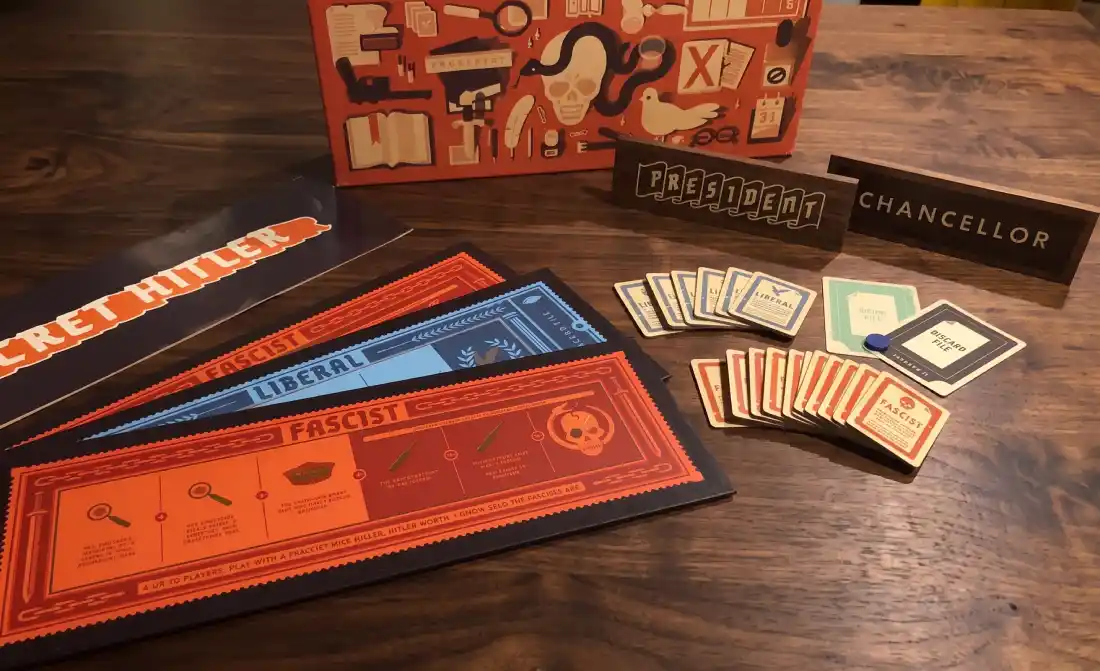
At a glance
- Players
- 5-10
- Play Time
- 30-60 min
- Ages
- 17+
✓ What We Love
- •The premise is amazing
- •It's a great party game, it's fast, there's giggles, it has everything
- •It kind of makes you feel like this really happened, he was voted to power
✗ Could Be Better
- •You need many players, it's not easy to play every time
- •You have to listen to an audio every time a new game starts
- •Caps out at 10 players, so it can't anchor a large party
About Secret Hitler board game review
Secret Hitler drops five to ten players into pre-WWII Germany, hands almost everyone a secret party loyalty card, and asks the table to keep running a government while one hidden player works to install a fascist dictatorship without ever getting caught. The box sells that as a race.
Two tracks, one Liberal and one Fascist, filling up tile by tile until somebody hits five or six. The first table I watched play it treated it exactly that way, counting red tiles out loud like a countdown. Then the fourth Fascist Policy went up, a quiet, mostly-silent player got voted in as Chancellor almost by default, and the game just ended. Fascists win.
Somebody asked why Hitler hadn’t won the last time this happened, back at policy three. Nobody had a good answer, because nobody at that table had actually been playing the game in front of them.
That confusion shows up constantly with new tables, and it isn’t really their fault. The rulebook says the quiet part out loud in its own strategy notes: Fascists win far more often by getting Hitler elected Chancellor than by grinding out six Policies. The track is real, but it’s a clock running in the background, not the contest itself.
The contest is whether one specific player can behave like an ordinary Liberal for forty-five straight minutes, avoid picking fights, avoid getting clever, and end up handed the chancellorship once the table has stopped paying close attention. Winning as Hitler has nothing to do with outmaneuvering anyone. It’s about never once looking like the person you are.
That reframing changes what’s worth doing at the table. A good Fascist team isn’t the one making bold plays, it’s the one building a case for its own innocence out of completely ordinary behavior: voting the way a Liberal would, occasionally getting burned by a bad government the same way an honest player does.
A good Liberal team stops treating every Fascist Policy as a personal betrayal and starts treating it as data, tracking who touched which government and who’s been suspiciously easy to agree with. And every table eventually arrives at the same moment: someone has to be shot on a hunch, and the whole game turns on whether the hunch was right. Get it wrong and you don’t just lose ground, you watch the rest of the round in silence from an empty seat.
The production earns its reputation before a single Policy tile gets played. Mackenzie Schubert’s art carries the whole look, stark red-and-black propaganda-poster graphics that make the box feel dangerous just sitting closed on a shelf.
The Secret Role and Party Membership cards go out inside heavy brown paper envelopes, a genuinely good design call since dealing out sealed envelopes does more for the tension of the moment than a stack of face-down cards ever could.
The President and Chancellor plaques are real wood, with the relevant rules printed on the back so nobody’s fumbling through the booklet mid-round. The one real complaint, and it’s a fair one: the Secret Role and Party Membership cards themselves are standard stock rather than the thicker cardboard some backers expected for pieces meant to stay hidden in a player’s hand for the entire game. It doesn’t affect play, but it’s a real gap between how the rest of the box is built and how its most-touched pieces feel.
Finding Your Table’s Real Player Count
Secret Hitler officially runs 5 to 10, but ask five different regular groups which number is “right” and expect five different, well-defended answers. At five, games move fast and Liberals tend to sniff out the Fascists quickly, tense but occasionally too easy for the good guys. Six is the number most tables agree plays worst, oddly Liberal-favored until everyone’s logged enough games to correct for it. Seven and eight get named most often as the real sweet spot, and there’s a mechanical reason for it: at seven or more players, Hitler stops being told who the other Fascists are, which changes what surviving as Hitler actually requires. Nine and ten look like the payoff for owning the bigger box, but Hitler can hide inside a crowd that size, and the odds quietly tilt Fascist. None of this is a flaw so much as a game that plays differently depending on how many chairs are at the table, worth knowing before treating any single count as the definitive version.
It also depends on who’s in those chairs. This is a strong fit among the site’s party games once a table understands what it’s asking of them, not a light icebreaker, but a game built on lying convincingly to friends, partners, and coworkers for the better part of an hour.
The title itself splits a table before a single card is dealt, worth knowing going in rather than discovering mid-explanation. Once a table is clear on what it signed up for, the good version of this game is very good. Skip that step and it’s a long night spent explaining parliamentary procedure to people who wanted to be lying to each other five minutes ago.
How It Stacks Up Against the Rest of the Genre
Secret Hitler didn’t invent hidden-role deduction, and it isn’t the cleanest version of it either. The Resistance strips away a fixed identity in favor of a tighter, repeatable mission structure, and plenty of players prefer that precisely because it demands less performance and more pure deduction. Avalon leans the same direction, rewarding a case built from facts over staring someone down until they crack.
Two Rooms and a Boom solves a problem Secret Hitler flatly can’t: it scales to a real party-sized group, twenty or more, by splitting the table into two physical rooms instead of capping out at ten chairs. None of that makes Secret Hitler worse at its own job. It’s the one in this lineup built for a genuine confrontation instead of a polite vote, which is exactly why it plays best at a table that already knows and half-trusts each other, not a room of strangers meeting for the first time.
Hand it to a casual group looking for a quick icebreaker and it can feel like too much commitment for too little payoff. Hand it to the same six or seven people every other week and it turns into the game they keep coming back to.
📖 Rulebook
How to Play Secret Hitler
Setup
- Select the Fascist Track that matches the player count and place it beside the Liberal Track.
- Shuffle all 17 Policy tiles (6 Liberal, 11 Fascist) face down into a single Policy deck.
- Fill one envelope per player with a Secret Role card, a matching Party Membership card, one Ja! Ballot card, and one Nein Ballot card. Liberal Secret Role cards always pack with a Liberal Party Membership card; Fascist and Hitler Secret Role cards always pack with a Fascist Party Membership card.
- Shuffle the envelopes and deal one to each player at random. Every player privately examines their own Secret Role.
- Randomly choose the first Presidential Candidate and pass them the President and Chancellor placards.
- Run the blind identity reveal for the table's player count:
- 5-6 players: everyone closes their eyes, then Fascists and Hitler open their eyes and silently acknowledge each other, then everyone closes their eyes again before opening them for good.
- 7-10 players: everyone extends a closed fist; Fascists (not Hitler) open their eyes and identify each other; Hitler keeps eyes closed but extends a thumbs-up so the Fascists can identify Hitler, though Hitler still does not know who the other Fascists are.
Your Turn
Each round runs through three phases in order.
- Election. The President placard passes clockwise to the next player, the new Presidential Candidate. That player nominates any other eligible player as Chancellor Candidate. Every player, including both candidates, votes Ja or Nein simultaneously.
- A majority Ja elects the government. If three or more Fascist Policies have already been enacted, the table must ask the new Chancellor if they are Hitler; if yes, the game ends immediately and the Fascists win.
- A tie or a majority Nein fails the government. The President placard advances to the next player and the Election Tracker moves forward one space.
- If three governments fail in a row, the Election Tracker maxes out: the top Policy tile is enacted automatically with no Presidential Power triggered, the tracker resets, and all term limits reset.
- Legislative Session. The President draws the top three Policy tiles, looks at them in secret, and discards one face down. The remaining two pass to the Chancellor, who looks at them in secret, discards one face down, and enacts the last tile face up on the matching track. The President and Chancellor may not communicate about which tiles they saw or discarded, may not select tiles at random, and discarded tiles are never revealed to the table.
- Executive Action. If the enacted Fascist Policy grants a Presidential Power, the sitting President must use it before the next round can begin.
Presidential Powers
- Investigate Loyalty: the President secretly views one player's Party Membership card. No player may be investigated twice in one game.
- Call Special Election: the President names any other player, term-limited or not, as the next Presidential Candidate. After the special round, the President placard resumes rotation from the player who called it.
- Policy Peek: the President secretly looks at the top three tiles in the Policy deck and returns them in the same order.
- Execution: the President eliminates one player from the game. If that player is Hitler, the game ends immediately and the Liberals win. If not, the table does not learn whether a Liberal or a Fascist was executed.
Veto Power
Once the fifth Fascist Policy has been enacted, every future Legislative Session gains a permanent option: after seeing their two tiles, the Chancellor may propose a veto instead of enacting either one. If the President agrees, both tiles are discarded, no Policy is enacted, and the Election Tracker advances by one. If the President does not agree, the Chancellor must enact a Policy as normal.
Winning
- Liberals win by enacting five Liberal Policies, or by executing Hitler at any point in the game.
- Fascists win by enacting six Fascist Policies, or by having Hitler elected Chancellor at any point after the third Fascist Policy has been enacted.
Role distribution by player count:
| Players | Liberals | Fascists (incl. Hitler) |
|---|---|---|
| 5 | 3 | 1 + Hitler |
| 6 | 4 | 1 + Hitler |
| 7 | 4 | 2 + Hitler |
| 8 | 5 | 2 + Hitler |
| 9 | 5 | 3 + Hitler |
| 10 | 6 | 3 + Hitler |
Eligibility and term limits: the most recently elected President and Chancellor are term-limited and cannot be nominated as Chancellor Candidate in the next round. Term limits apply only to the Chancellorship, not the Presidency, and only to players who were elected, not merely nominated. With exactly five players remaining, only the last elected Chancellor is ineligible; the last President may be renominated.
On lying: players may lie at any time about hidden information, including the contents of Policy tiles they've seen or the results of an investigation. The only exception is a game-ending, Hitler-specific moment: a player who is Hitler must answer truthfully if asked directly after being elected Chancellor post-third-Fascist-Policy, or if executed.