In this article
The player count, and the people behind it.
Catan plays three to four people straight out of the box. Bolt on the 5-6 Player Extension and you can stretch it to six. You can also drop down to two with the official variant, though I will get to why that one feels like eating dinner alone in a restaurant that used to be fun.
So the number is three to four, or two to six if you own the right cardboard. It has sat on the side of the box since 1995 and it is not the complicated part.
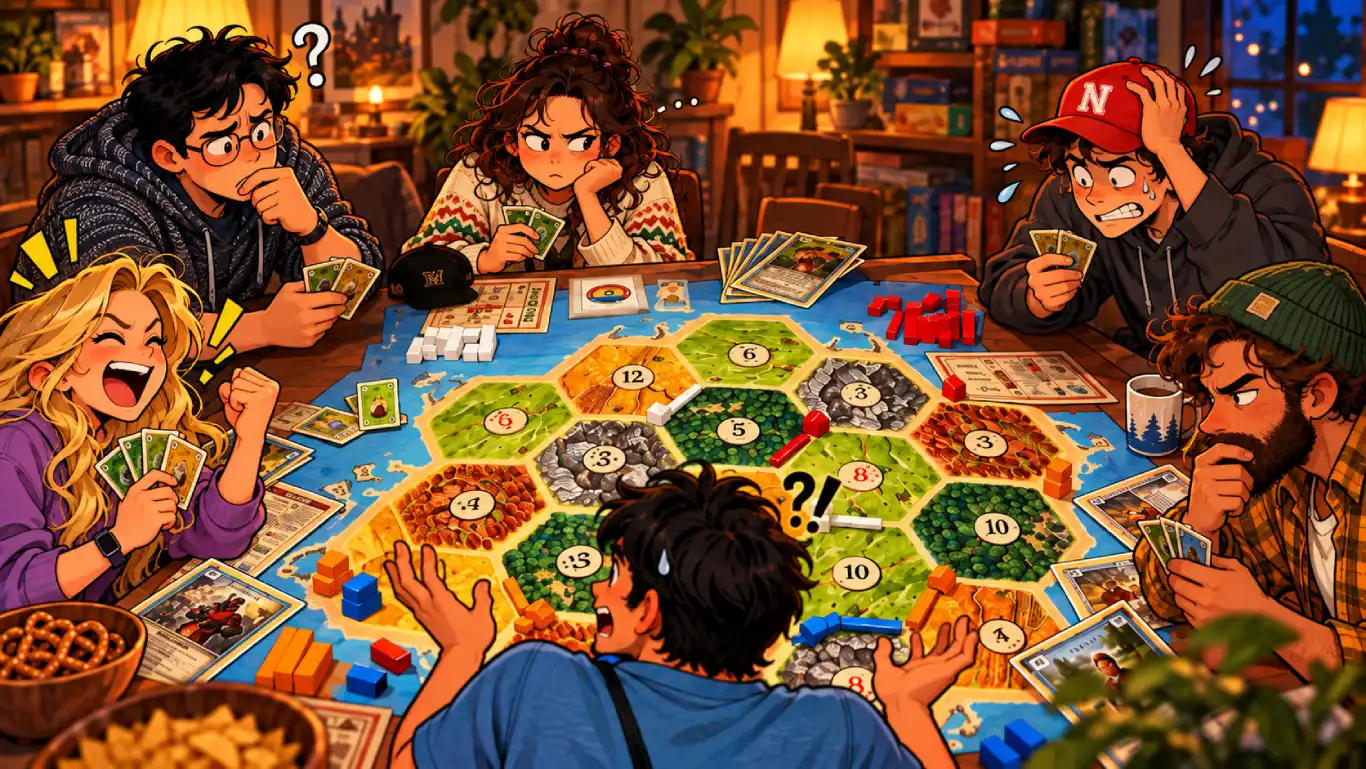
The complicated part is who those three or four people turn into the moment the robber comes off the board and somebody looks you dead in the eye and says they have no brick. They have brick. Everyone can see the brick. This is the real player count question, and the box does not cover it.
I have played with all of them. Here is the field guide.
The Short, Honest Count
Before the character study, the thing you came here to confirm:
- Base game: 3 to 4 players.
- With the 5-6 Player Extension: up to 6.
- Two players: doable with the official rules or a well-known variant, not the version of Catan anyone fell in love with.
Three is the quiet sweet spot nobody will admit to, because admitting it means telling the fifth person they cannot play. Four is the honest default. Five and six are a commitment, and we will talk about what you are committing to.
Now the people.
The One Who Parks the Robber on You Personally
There is a correct, strategic place to put the robber: on whoever is winning, blocking their best number. This person does not care about that. You said something about their haircut in 2019 and now the robber lives on your ore like it pays rent. They will skip the player in first place to keep you at seven cards and shaking. You are not losing to Catan. You are losing to a grudge wearing a board game as a costume.
The Road Builder Nobody Asked to Stop
Longest Road is two points. Two. This player will spend eleven turns, every spare stick of wood, and the full emotional range of a Greek tragedy defending it from a rival who was never actually contesting it. Meanwhile someone quietly built three cities. Watch the road people. They are so busy winning the subplot that they forget there is a main plot, and honestly the table is more peaceful when they are distracted.
The Trader Who Signs Nothing in Blood
“Sure, I’ll give you a sheep next turn.” Reader, there is no next turn sheep. There was never going to be a sheep. This player negotiates like a used car lot, promises future goods that evaporate the instant the dice favor them, and then acts wounded when you stop trading with them entirely. Catan is a game about trust between people who have no reason to trust each other, and this person is the reason the game works. Spite is a resource.
The Quiet Engine in the Corner
Says almost nothing. Trades fairly, which should have been your first warning. Buys development cards face down, one after another, with the patience of someone who has read the whole rulebook and intends to use the boring parts. Then on turn fourteen they flip Largest Army, play a Victory Point card they have been sitting on for an hour, and win by two before anyone noticed they were a threat. The loud players fight over the robber. This one was building the whole time. Players like this tend to drift toward the heavier end of the strategy games shelf sooner or later.
The Kingmaker With Nothing Left to Lose
Mathematically eliminated around turn ten, and now the most powerful person at the table. They cannot win. They have decided that is everyone’s problem. Every trade, every robber placement, every blocked road for the rest of the game is a referendum on who annoyed them least. Entire Catan victories have been handed out, not earned, by a player whose only remaining goal was to make sure a specific someone else did not get there. Keep them fed and flattered. It is cheaper than the alternative.
The One Who Brought the Extension
Walks in with the 5-6 Player Extension like it is a magnum of champagne. More friends, more fun, surely. What the extension actually adds is a special build phase at the end of each round so the extra players do not die of boredom between turns, and it works, mechanically.
It also turns a snappy ninety-minute game into a march. Five and six players is Catan with the same rules and triple the waiting, and by the time your turn comes back around the entire board has changed and the trade you planned is dead. Bring snacks. Bring patience. Bring fewer opinions about whose turn it is.
So, Two Players?
Here is where I stop being funny for a second, because people search this one hoping for good news. The base game at two is a worse game than the base game at three, and that is not snobbery, it is design. Catan runs on a trading economy, and a trading economy with one other person in it is just two people refusing to help each other until someone wins on their own cards.
The tension that makes Catan sing, the three-way “if I help you, I help them too” math, is gone. There are fixes, the official two-player rules and the popular “neutral player” variants among them, and they are fine. Fine is the ceiling. If it is just the two of you, I would reach for almost any dedicated two-player game first, and I say that as someone who owns too much Catan. The full rules breakdown and where the base game cracks at low counts are in my Catan review if you want the receipts.
Which One Are You
You can feel the recognition starting already. The robber person always thinks they are the quiet engine. The kingmaker always thinks they are being reasonable. So let’s settle it. Six situations, no right answers, one diagnosis you probably won’t enjoy.
The real answer to how many players Catan takes is three to four, six with the extension, two if you must. The better answer is: however many people you are willing to not speak to for the rest of the evening. Pick your number accordingly.