In this article
Space King’s Kickstarter closed at $9.5 million.
Updated October 14, 2026, with the campaign’s final results.
Flashgitz asked for $50,000 to turn its YouTube parody of Warhammer 40,000 into a board game. Kickstarter’s own badge on the page says it was funded in six minutes. When the campaign closed on September 25, the final tally was $9,561,616 from 26,090 backers, roughly 19,000% of the goal.
The campaign’s tagline never pretended to be anything else: “Crush aliens, plunder loot, and enslave children in this rip-roaring SPACE KING action game PACKED with minis and lore.” If that line makes you flinch a little and laugh anyway, you already understand the show.
If you don’t watch Flashgitz, here is the fast version. Tom and Don make an animated series called Space King, which takes 40k’s grimdark shtick (genetically engineered supersoldiers, an absent god-emperor everyone worships and nobody has seen, a galaxy of xenophobic murder machines who call it duty) and plays it completely straight while the soldiers behave like violent, easily distracted teenagers. The Captain wants to deploy genocide bombs because that is just what you do. Flashgitz will tell you, with a straight face, that none of this has anything to do with Warhammer. Nobody believes them, and that is the joke.
How a $50,000 Goal Became $9.5 Million
A $50,000 ask is modest for a miniatures-heavy board game, and the crowd cleared it before most people had finished reading the page. Around 5,400 backers showed up on day one and the total passed $2 million inside 24 hours. Then the campaign ran another three and a half weeks.
The average pledge settled around $367, which is what $9.56 million across 26,090 backers works out to. A typical impulse buy for a funny board game runs $30 to $50, so that number looks like miniatures-hobby spending, which is what this audience turned out to be. It also sits above the $299 price of the middle tier, so plenty of people bought the full box and stacked more on top.
| Tier | Price | What it gets you | Final backers |
|---|---|---|---|
| Recruit | $99 | The base game, $20 under eventual retail | 4,857 |
| Psycho Warrior | $299 | Base game + War World, B-Positive, Psycho Warrior Pack, Weapon Pack, Space King Favor, Lore Book | 17,624 |
| Super Psycho Warrior | $699 | Everything above plus a metal game box and a Tom & Don signed medal | 2,260 (capped at 3,000) |
| Psycho Monster | $1,199 | Everything above plus a custom audio line from a Space King character | 156 (capped at 175) |
| Globulus Maximus | $7,777 | Everything above plus your face turned into a Psycho-Warrior in a future episode | 15 (sold out) |
More than seven in ten backers who picked a reward tier landed on the $299 Psycho Warrior box, not the $99 base game. The real story in the numbers is that this was never a crowd testing the water at the cheapest entry point. It decided early that it wanted the full stack.
The Psycho Monster cap grew from the 75 slots it launched with to 175, which means a stretch goal or a manual bump made room for more people to pay $1,199 for a personalized audio line, and backers filled 156 of them. Globulus Maximus, the $7,777 tier that writes your likeness into a future episode, sold out its 15 slots.
The $299 tier also carries the stretch goals, which the campaign’s FAQ says were added to pledges automatically. The last two unlocks, at $6.25 million and $6.75 million, were new game modes rather than more plastic.
Crusades turns Space King into a linked campaign where your character carries progress, Favor cards and a growing pile of Psychosis abilities across sessions, with players free to drop in and out. Mission Modifiers add rule twists, and the example on the page, “Heroes and Heretics,” hands everyone a secret card that says either Loyal to Space King or Maybe We’re the Bad Guys, so the betrayal angle gets a hidden-role layer.
What’s in the Space King Board Game Box
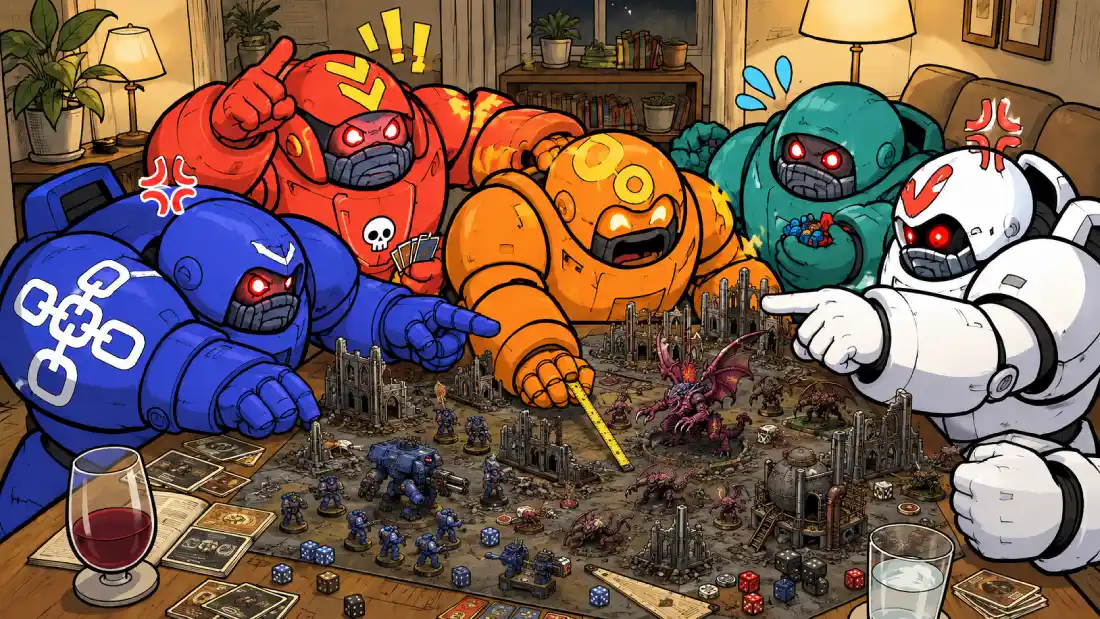
Strip away the merch-drop energy and there is a real game design underneath, at least on paper. Two to four players take Psycho Warriors through five missions, working together to kill aliens and clear objectives while separately racking up points to become the Space King’s personal favorite, the same push-and-pull that makes the best semi-cooperative strategy games worth returning to.
The structure is semi-cooperative. Everyone needs the team to survive, only one of you wins, and Tactics Cards let you help another player or sabotage them outright.
A Command Deck runs enemy behavior so nobody is stuck babysitting the AI, and an Event Deck keeps missions from playing identically twice. Die in combat and you respawn instead of sitting out, which suits a game clearly betting on chaos over careful positioning.
The minis are the headline for a lot of backers. Psycho Warriors run around 50mm, standard enemies come in at roughly 36mm, and boss figures top out past 100mm.
Pre-painted and paintable versions both exist depending on tier. Jacen Sievers gets the designer credit, Edgar and Lander Ramos sculpted, Javier Navarro led the art, and Marta de Paz illustrated the Tactics Cards on her own, which tells you someone cared enough about that one subsystem to hire for it. The full rulebook was posted as a public download on the campaign page instead of sitting behind a pledge, which plenty of minis-first campaigns never bother with.
Who Designed Space King: The Board Game, and the Timeline So Far
Jacen Sievers is the designer. Flashgitz credits him on the campaign page and again in its FAQ, which says he made the game with the guidance and support of Tom and Don themselves. He also joined both creators for the September 1 livestream playthrough, the one appearance by him that I could confirm during the campaign.
Past that, the public record is thin. The listings I could check show no earlier published games under his name, and no designer interview has surfaced in coverage of the campaign. How he came onto the project is not stated in any public source.
The studio behind the build is Warren James, a brand development and merchandising company that has made Space King products with Tom and Don for years. It says it paired with the creators about two years before launch to design the game, and it has said its tabletop plan depends on recruiting designers who already work in that space.
| Date | What happened |
|---|---|
| Around 2024 | Flashgitz and Warren James start building the board game |
| Aug 8, 2026 | Game announced, email signup opens with a free pin for backers |
| Aug 30, 2026 | Kickstarter opens and funds in six minutes; Space King 5 releases the same day |
| Aug 31, 2026 | Pledges pass $2 million inside 24 hours; extra loot cards added to every copy |
| Sep 1, 2026 | Livestream playthrough with Sievers; next stretch goal revealed on air |
| Sep 4 to 24, 2026 | Weekly updates add a decal sheet, more loot cards, alt-pose minis and a glow-in-the-dark extra; the Bryce Lives goal unlocks Sep 15 |
| Sep 25, 2026 | Campaign closes at $9,561,616 from 26,090 backers |
| Late 2026 to early 2027 | Pledge manager opens; shipping, VAT and tariffs collected |
| December 2027 | Estimated delivery to backers |
| Early 2028 | Standard game and expansions reach the Flashgitz store |
Dates are current as of October 14, 2026. The pledge manager window comes from the studio’s own “two to three months after close” estimate, and delivery dates on crowdfunded minis games tend to move.
Space King vs Warhammer: Why the Parody Works
Games Workshop will not feel $9.5 million financially. What should needle them is what Space King is as satire.
It does not invent a joke about 40k from the outside. It plays the lore straight and lets you notice how insane it already is: an absent god-king worshipped without question, soldiers whose whole personality is genocide and loyalty, a universe with zero room for nuance. None of it is exaggeration. It is the pitch itself, delivered without the seriousness Games Workshop usually wraps around it. The show works because it loves the source enough to know which buttons to push.
Whether the board game earns the same read is still open. A crowdfunded minis game backed by a comedy audience has a well-worn failure mode: gorgeous sculpts, thin rules, a box that photographs great and plays like an afterthought. Flashgitz’s own risk disclosure says the final product will differ from the prototypes shown on the page.
Standard Kickstarter language, sure, but it is also the honest version of my point: nobody, including the people making it, is promising the shelf copy plays exactly like the pitch.
The instincts on paper are right, with betrayal built into a cooperative shell, respawns instead of elimination and a Command Deck doing the GM’s job. Execution is a different conversation, and it cannot happen until tables get to break the game.
Missed the Space King Campaign? What Happens Next
The campaign ended September 25. Flashgitz’s FAQ says you can still pledge afterward, with one catch: campaign pricing and campaign-only items do not carry over. Standard copies and expansions reach the Flashgitz store only after every backer reward ships, which the studio puts at early 2028.
Rewards themselves are pointed at December 2027, and shipping was not charged during the campaign. Flashgitz will collect shipping, tariffs and fees closer to fulfillment through a pledge manager, and has promised refunds to backers who cannot afford it if rates run more than 25% above its highest estimate.
Anyone who has backed a miniatures campaign knows that date is a starting point for negotiation. Scale makes it harder here, not easier. The studio planned for a $50,000 project and now has to manufacture and ship boxes of plastic for more than 26,000 people.
If you are already a Space King fan, you know whether $99 buys a fun night or guilt about unpainted plastic in a closet. If you missed the window and are not a fan of the show, waiting for reviews of real copies costs you very little. I would treat anything past the Psycho Monster tier as a donation to a YouTube channel you already like, not a board game purchase, and the fifteen people who bought the top tier probably know that too.
I will circle back once copies exist and people who are not already fans have had a table with it. Until then, the only thing confirmed is how much an audience will pay to own a piece of a joke it loves, and the answer was: $9,561,616.