In this article
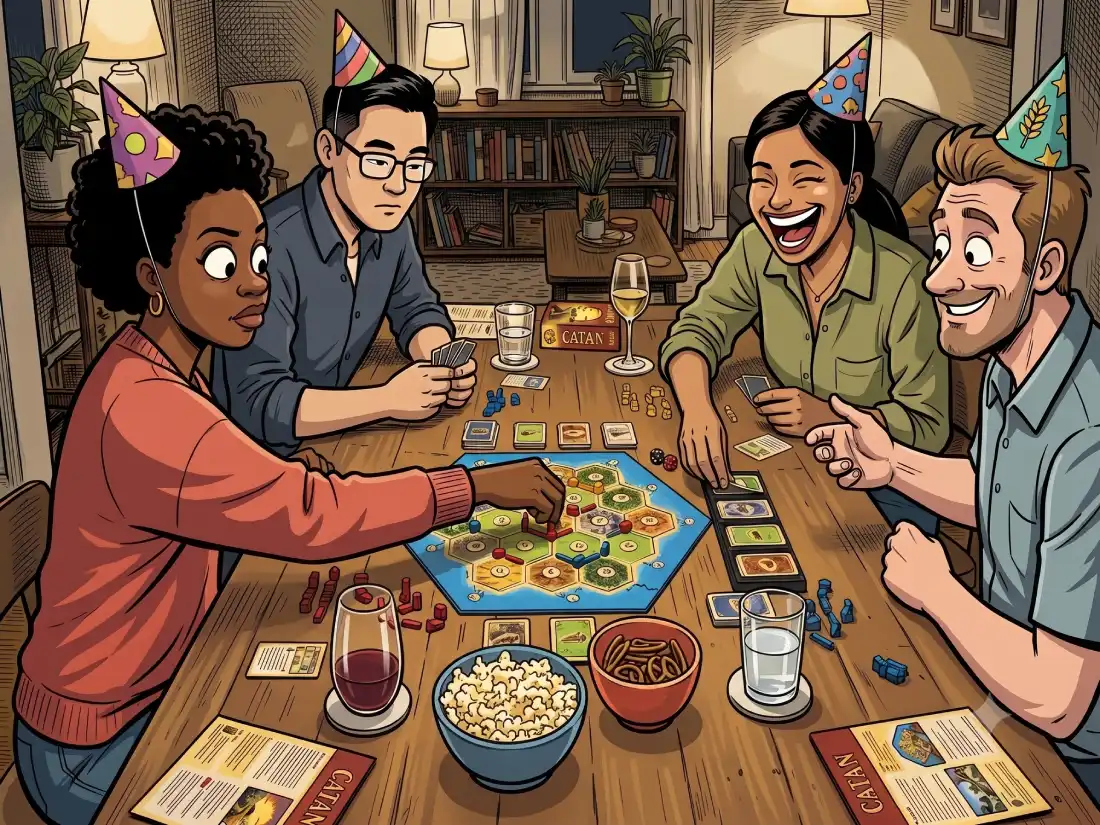
The base Catan box is built for 3 to 4 players, full stop, that’s what’s printed on the box and it’s also the honest answer once you’ve played it enough times to notice why. Go under that range and the game changes shape in ways most people don’t expect until they’ve tried it. Go over
The base Catan box is built for 3 to 4 players, full stop, that’s what’s printed on the box and it’s also the honest answer once you’ve played it enough times to notice why. Go under that range and the game changes shape in ways most people don’t expect until they’ve tried it.
Go over it and you’re not playing Catan anymore unless you own the right add-on. Here’s what happens at every player count you might be considering, and which ones are worth the trouble.
The Official Range Is 3 to 4 Players
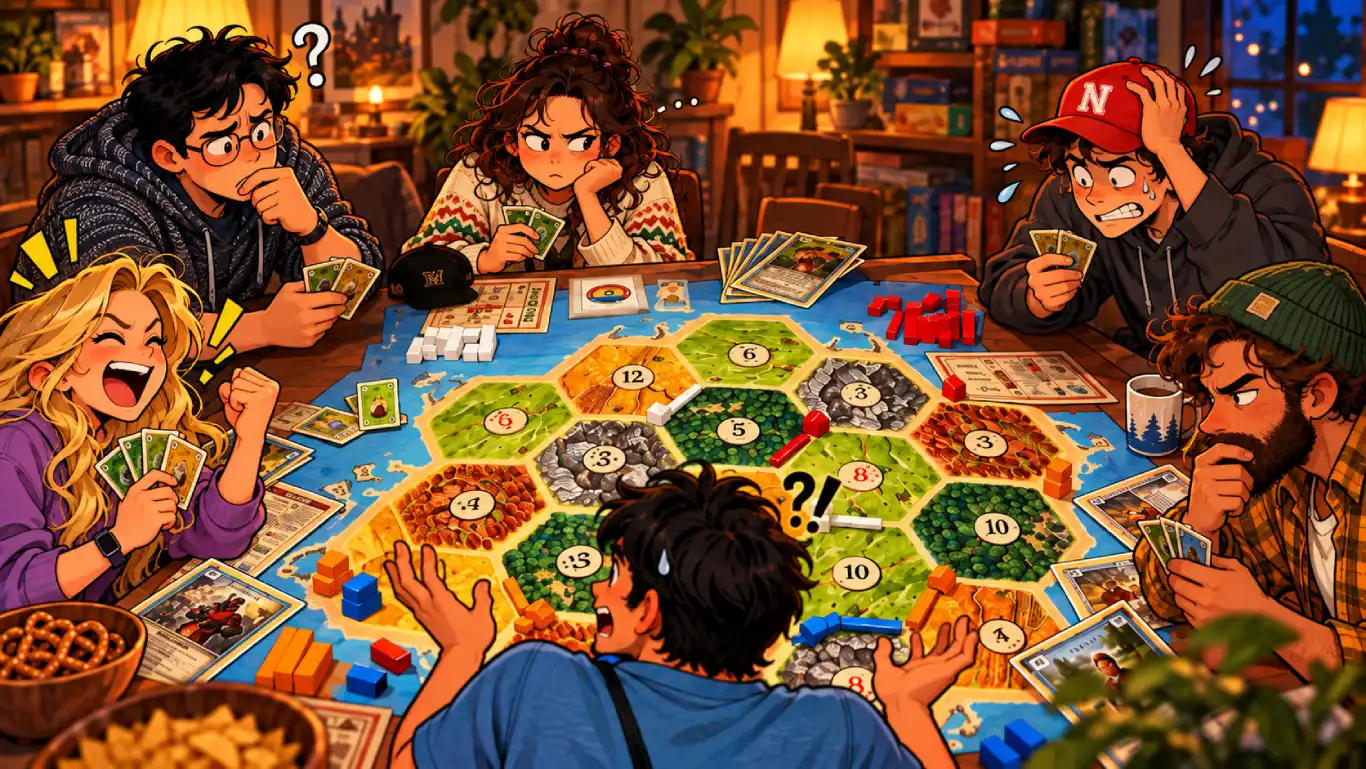
Every rule in the base rulebook, from harbor placement to the 19-hex board itself, is tuned around three or four settlers competing for the same handful of good intersections. The box only ships four sets of settlements, cities, and roads for exactly that reason, this game was never meant to seat a fifth person without help. Four is where it runs best, and it’s not a marginal difference.
Trading has enough participants that refusing someone costs you real options instead of just mildly inconveniencing them, the robber has enough targets that it functions as a genuine check on whoever’s ahead instead of a coin flip, and the board fills up at close to the right pace to make the late-game land grab feel tense instead of empty.
With four people fighting over roughly nineteen hexes, good spots run out fast, and that scarcity is where most of the game’s real tension lives.
Three works too, it’s a slightly quieter version of the same experience. You’ll have fewer trade partners and fewer grudges forming at once, and the board has a bit more breathing room since there’s one fewer set of settlements competing for the same intersections.
I still recommend three over two without hesitation, it’s a different tier of experience entirely even though it’s just one player short of the ideal count. The dynamics that make Catan worth playing, reading who’s willing to deal and who isn’t, are already present at three, just quieter than at four.
Two Players Is Technically Legal, Rarely Recommended
Nothing in the rulebook stops two people from sitting down and playing. It just isn’t the same game once you do. I’ve written before about why I don’t recommend Catan at two players, and the short version holds up every time I test it again, trading collapses into pure arithmetic when there’s only one other person to deal with, since you both know exactly what the other needs and neither of you has any reason to give it up.
The social pressure that makes four-player Catan interesting, the grudges, the reads, the quiet decision to freeze someone out for three turns because of something that happened last game night, simply has nowhere to live with just two people at the table. There’s no third party to read, no coalition to build or break, and no one to punish except the person sitting across from you, which makes every interaction feel personal in a way that isn’t more interesting, just more awkward.
The board still works mechanically at two players. Roads get built, cities go up, someone eventually hits ten points. It just stops feeling like Catan somewhere along the way, and starts feeling like two people doing parallel arithmetic on the same table, each one calculating exactly how much the other needs before deciding whether to help.
I’ve tried it more nights than I’d like to admit, usually when a third person cancelled last minute, and it’s never once produced the kind of tense trading standoff that makes a full table memorable. If you’re determined to play at two anyway, look at a dedicated 2-player variant built for that format rather than forcing the base game to do something it was never designed to do.
Five or Six Players Needs the Extension
If you want more people at the table, you need the official 5-6 Player Extension, not a house-ruled workaround using spare pieces from another copy. The extension adds extra terrain hexes, more number tokens, and additional roads and settlements for each new player, and it genuinely reshapes the board’s geometry, more coastline, more harbors, more usable intersections so a bigger group has anywhere to actually settle.
Trying to cram five or six players onto the standard 19-hex board without it produces a cramped, resource-starved mess where half the table can’t find a single legal spot by the third settlement round. The extension isn’t optional at this player count, it’s the only way the game holds together once you’re past four.
Budget your evening accordingly if you’re going this route. Setup takes noticeably longer with the extra pieces, turns take longer once six people are all fielding trade offers, and a full six-player game can easily run past two and a half hours once the negotiating gets serious.
It’s worth it for the right group, a bigger table means more simultaneous alliances and more chances for someone to get quietly ganged up on, but it’s a bigger commitment than a standard game night, plan for it rather than discovering it mid-session.
Buy the extension carefully, especially secondhand or from a third-party seller online. Catan has gone through enough print runs over the years that component sizes and even hex art have shifted between editions, and a mismatched extension can be more than a cosmetic annoyance.
My own base set is an older printing, and the extension I eventually bought for it has terrain hexes a couple of shades darker than the rest of my board, noticeable enough that a few people I play with genuinely can’t stand looking at the mismatch once it’s laid out.
Card and tile dimensions have also changed slightly between printings, so an extension bought without checking the edition can end up not fitting cleanly into the same box, or sitting oddly next to your existing pieces at the table. Check that you’re buying an extension matched to your specific edition before you click purchase, not just the one with the right name on the box.
One thing that trips people up: the base 5-6 Player Extension only covers the base game. If you also own Seafarers or Cities & Knights and want to play either of those at five or six players, you need that expansion’s own dedicated 5-6 extension, they’re sold separately and they aren’t interchangeable with the base extension’s pieces.
I’ve seen people buy the base extension, assume it covers everything on their shelf, and find out mid-setup that their Seafarers box still tops out at four.
Check which expansions you actually own before assuming one extension purchase covers your whole collection.
Player Count at a Glance
| Players | ✓ Best For | ✗ Watch Out For |
|---|---|---|
| 2 | A quick fix when a third person cancels | Trading collapses into pure math, no real social tension |
| 3 | A solid backup when you’re one short | Quieter game, fewer trade partners and grudges |
| 4 | The count the whole game is designed around | Nothing, this is the target experience |
| 5-6 | Longer, louder, more chaotic in a good way | Requires the official extension, plus a separate one per expansion you own; turns and setup both take longer |
The Best Player Count, If You’re Choosing
If you’re picking a number specifically to get the best version of the game, go with four. It’s not close. Three is a perfectly good backup when you’re short a player, the game just runs a touch flatter with fewer trade partners in the mix, still worth playing, just not the peak experience.
Five or six with the official extension is a genuinely great time for a bigger group, longer, louder, and more chaotic in the best way, but it asks for a full evening and a table big enough to actually fit the expanded board.
Two is the one player count I’d steer people away from outright unless you already own the base game and have no other option that particular night.
Catan was built around a crowd large enough to have real opinions about each other, form real alliances, and hold real grudges across turns. Every player count question on this game ultimately comes down to how much of that social friction you actually want in the room, and the honest answer is: as much as you can fit around the table.