In this article
- Catan Strategy Cheat Sheet: Do This, Not That
- Catan Settlement Placement: Evaluating Your First Two Settlements
- Catan Resource Priority: What to Build, and When
- Catan Blocking Strategy: When to Pivot From Expansion to Development
- Longest Road vs. Largest Army: One Is a Trap More Often Than People Think
- Catan Mistakes That Actually Cost You the Game
- Catan Strategy for 5-6 Players: How the Paired Players Rule Changes Everything
- What Seafarers and Cities & Knights Change
- Catan Strategy Tips From a World Champion
- Secret Catan Strategies Basic Guides Never Mention
- Catan Strategy FAQ: The Three Questions I Get Asked Most
The 6/8 corner isn’t the strategy. Reading the table is.
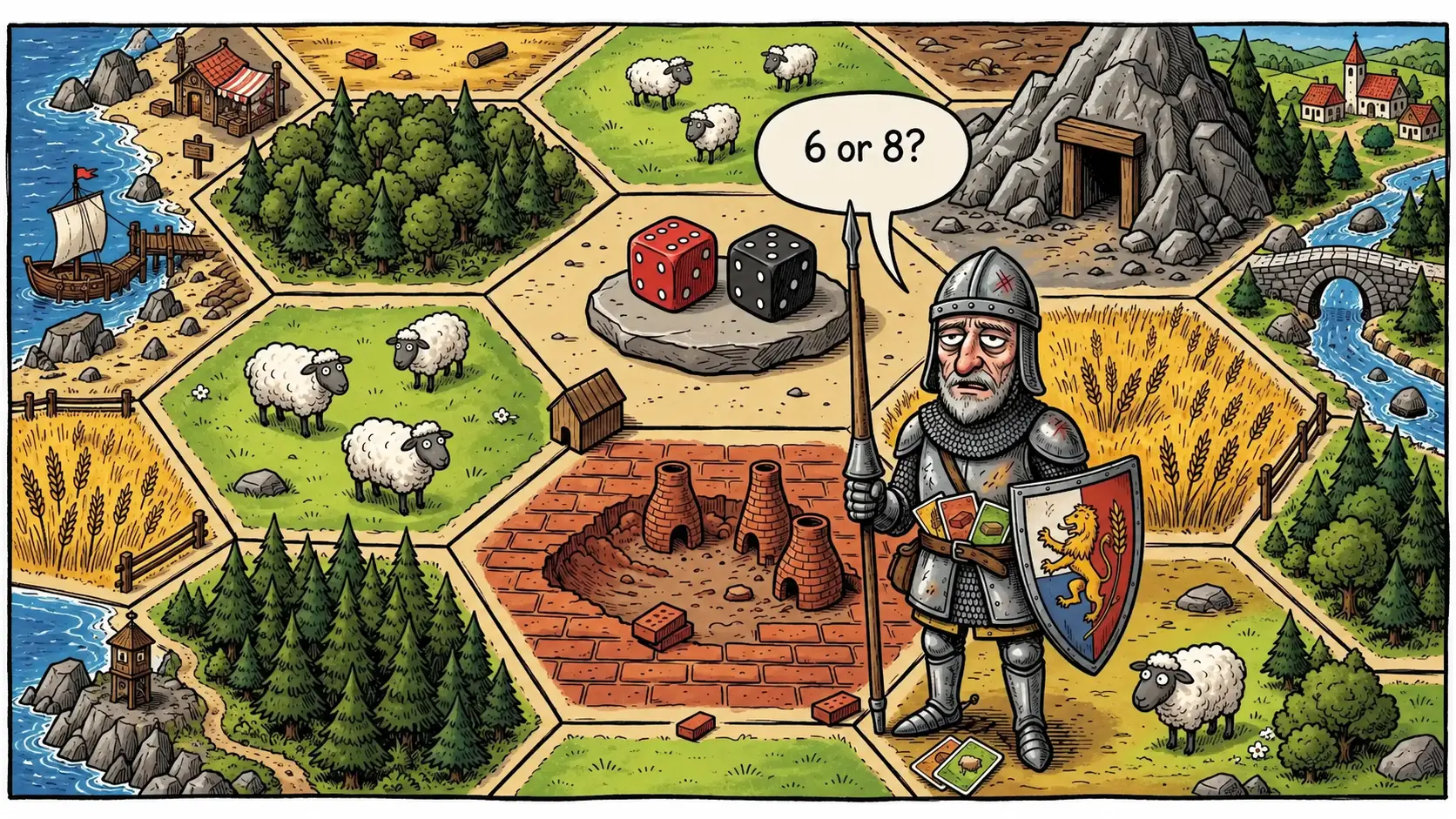
Every Catan strategy writeup out there gives you the same opening chart: settle on an 8 and a 6, grab two different resources, grab a port if you can. Not wrong advice. It’s the closest thing Catan has to an opening book. Just not the reason good ones beat bad ones. I’ve watched someone drop a textbook 8/6 opening and still lose to a player who settled on a 5 and a 9, because they read the table for thirty turns and never got attached to a plan.
Here’s the thing: the math only matters for one decision, your first two settlements. After that, Catan stops being about probability and starts being about paying attention. You’re tracking what everyone else needs, noticing who goes quiet when you ask about their production, catching the moment someone stops offering wheat because they’re already sitting on plenty. Winning consistently isn’t about memorizing pip counts. It’s about noticing things like that by turn six.
So this guide will split into three tiers. Jump to whichever one fits you: Fundamentals if you’re still getting the hang of a good placement, Reading the Table once the rules feel automatic and you’re ready to watch everyone else, and Advanced if you already know all that and want the content most experts skip entirely.
Three tiers, three sets of strategies, each expanding on the last. Every section pairs the reasoning with the move: why the math or the table dynamic works the way it does, then exactly what to do with that at your next turn. If you just want the answer without the why, skip to the FAQ near the bottom.
If you just want the short version before diving in, here it is:
Catan Strategy Cheat Sheet: Do This, Not That
| Do | Don’t |
|---|---|
| Settle while expansion room still exists | Skip whatever has no plan behind it |
| Prioritize upgrades once you’re boxed in, they double your output per hex | Hoard cards waiting for a “perfect” moment that rarely comes |
| Ask every turn, worst case is someone says no | Over-swap with the bank at 4:1 in the opening turns |
| Diversify your number coverage past just 6 and 8 | Chase either two-score race as a standalone goal from turn one |
| Swap for information, not just goods | Negotiate during your Paired Players mini-turn in 5-6 player games |
Everything in that table gets explained properly below, this is just the version you can screenshot; the actual content follows section by section.
Part One: Fundamentals
Catan Settlement Placement: Evaluating Your First Two Settlements
Fundamentals: start here if you’re still learning how a placement actually pays off.
Start with the numbers. They’re the one thing in this game that’s fixed. Two dice make a bell curve, not a flat line, and it’s not a small difference. Place your first move by that curve; trust your gut for the second.
| Roll | Combinations | Probability |
|---|---|---|
| 6 or 8 | 5 of 36 | 13.9% each |
| 5 or 9 | 4 of 36 | 11.1% each |
| 4 or 10 | 3 of 36 | 8.3% each |
| 3 or 11 | 2 of 36 | 5.6% each |
| 2 or 12 | 1 of 36 | 2.8% each |
A spot touching a 6 and an 8 pays off roughly twice as often as one touching a 3 and an 11. That’s why “grab the 6/8 corner” is standard advice, and why it’s usually gone by the second or third placement.
But the numbers alone won’t tell you which resources you’re getting, or whether you can use them.
Two wheat hexes look great until you realize you’re short a third type and can’t do anything interesting with them. I’d rather take a weaker spot that fills a real gap than a high-probability hex that just repeats what I already have. Four types beats three with one doubled, almost always. Going 4:1 with the bank is basically a tax on bad planning.
Ports only help if you’ll actually use them. A 2:1 wood port is dead weight if it’s not what you’re producing. I look for one matching what I’m already collecting in volume, not one I’d have to shape my whole strategy around, and honestly, I’ll take a decent hex over a flashy one, most days.
Last thing, and it’s the one beginners skip: check who’s next to you. A great hex that boxes you into one direction, with every route running into someone else’s territory, stops paying off around turn ten.
Give me a slightly worse hex with room to grow, every time. Where you place your second one matters just as much as the numbers on it.
Catan Resource Priority: What to Build, and When
Fundamentals: the priority order and swap logic that answers “what do I do with my resources right now?”
There’s a version of the same question everyone asks starting out: what do I get down first, when do I upgrade, and how hard should I be swapping? The order isn’t fixed, it shifts with your production, but there’s a real hierarchy worth knowing.
| Build | Cost | Produces per roll | Victory points | Best timing |
|---|---|---|---|---|
| Route | 1 wood, 1 brick | Nothing directly | 0 (2 points if it takes the trophy) | Only to reach new spots, or to contest the trophy |
| Settlement | 1 wood, 1 brick, 1 wheat, 1 sheep | 1 resource per adjacent hex | 1 | Early-to-mid game, while expansion room still exists |
| City | 2 wheat, 3 ore | 2 resources per adjacent hex | 2 total (net +1 on upgrade) | Once expansion space runs out |
Settlements come first, almost always, as long as you have room to expand. A new one is a full extra income source: another two types, another seat at the table when trades are offered, and a step closer to winning. Roads only matter as the means to get there, or as leverage in that race covered above. They produce nothing on their own, so there’s no reason to put them down just for the sake of it.
That priority flips once expansion dries up, whether the board’s full or you’re boxed in. A city produces two resources per roll instead of one, on the same hex, at the same production number. That’s the single biggest jump available in the game, and it’s why ore and wheat, the two resources a city costs, are worth protecting hard once you’ve got two or three settlements down.
Trading follows the same logic: unblock whatever you’re building next, skip the stockpile. If you’re one wheat short of a city, that’s what you chase, even at a bad rate. The same logic applies to those purchases: buy them early when the table’s underpricing them, and don’t sit on a playable one out of caution, both covered above.
Part Two: Reading the Table
Catan Blocking Strategy: When to Pivot From Expansion to Development
Reading the Table: for those comfortable with the rules and starting to watch the other seats, not just their own hexes.
Nobody wins Catan by running the same plan for forty turns straight. The board tells you things along the way, and the ones who lose are usually still following their turn-one strategy in the endgame, because it worked early and they never checked back in, especially on what their opponents were doing.
First signal: if nobody’s visibly buying development cards by turn six or seven, key production is probably underpriced at the table. Going hard for them suddenly looks a lot better. I once switched from expansion to a full development grind because I watched three others swap ore for wood, twice, while everyone else built. Bought five in six turns. Had the army before anyone noticed what I was doing.
Second signal: if someone’s sitting on two 6-or-8 hexes for a matching pair, they’re about to out-expand the table unless somebody slows them down. That’s not the moment to keep quietly running your own plan. Race them for the same expansion routes, or stop feeding them trades that help their plans along. And blocking isn’t just about that piece. Half of it is simply refusing to be the one who makes someone else’s plan easy.
Third signal is about you, not them. If the robber keeps landing on your best tile, that’s not bad luck. It’s a sign everyone’s noticed how dependent you are on one hex. Diversify your production even if it costs you some expected value, because something that one robber placement can shut off completely isn’t reliable.
Fourth: if you’re close to a strong position but someone else is one draw away from that knight-count bonus or Longest Road, spend the turn denying them instead of expanding. Blocking a single connection can cost someone three turns of replanning. Your own expansion can usually wait one turn.
Longest Road vs. Largest Army: One Is a Trap More Often Than People Think
Reading the Table: the two-point traps that quietly decide close games.
Both are worth two points, and newcomers treat both like automatic goals. That’s exactly the trap. Neither is free, and chasing the wrong one at the wrong time wastes a good position fast.
| Longest Road | Largest Army | |
|---|---|---|
| Victory points | 2 | 2 |
| Minimum to claim | 5 connected roads | 3 knights played |
| Main cost | Wood and brick | Ore and wheat, plus luck on the draw |
| Biggest risk | Anyone can steal it just by growing past your count | Slow to grow, easy to under-commit and never catch up |
| Chase it when | It falls out of an expansion plan you’re already running | Your production genuinely favors ore and wheat |
It’s cheap to start and expensive to protect. Get the right hexes flowing early and five connected roads is often within reach by turn ten or twelve. The problem is anyone can steal it just by growing past your count, usually without even trying, they’re just expanding normally and happen to pass you. I’ve lost it twice that way.
That one costs real resources, one card, then another, hoping for knights instead of the route-building or monopoly cards you actually want. I’ve watched someone burn their entire hand chasing a third knight on turn thirty, only to hand the points to whoever had been quietly stacking cards the whole game. If you’re going to chase it, commit early. A slow, obvious chase just invites someone to steal it at the last second.
My rule: chase that record when it falls out of a plan you’re already running, not as its own goal. Chase the other only if your production actually supports the buy rate. Treat either one as a standalone strategy from turn one and you’ll end up with two points and nothing else to show for it.
Catan Mistakes That Actually Cost You the Game
Reading the Table: the habits that quietly decide who wins, repeated across forty turns without anyone noticing.
Most Catan losses aren’t dramatic. Nobody usually loses to one bad swap or one unlucky dice roll. They lose to the same small habits, repeated for forty turns, including a few I’ve made myself.
Chasing the Road record or Largest Army as a goal instead of a side effect tops the list, covered above. Fastest way to turn a strong position into a mediocre one.
Over-trading with the bank early is next. Going 4:1 should be a last resort, not a habit, and beginners lean on it constantly because it feels like progress. That’s resources you could’ve saved for a real swap at half the cost.
Settling into a box canyon is almost purely a beginner mistake, covered above, but easy to miss when you’re staring at pip counts instead of the map.
Sitting on unused cards is a habit worth breaking too. New players wait for the perfect moment to use a knight or a route-builder. That moment rarely comes, and holding it too long does nothing. Run them often, most cost you almost nothing even when they flop. Monopoly punishes that habit hardest, since it’s worthless the turn everyone else has already spent their surplus.
And in 5-6 player games specifically: skip negotiating during your Paired Players mini-turn. Easy rule to forget under pressure, and an easy tell too, offering a swap there just announces you’re stuck.
Part Three: Advanced and Tournament-Level
Catan Strategy for 5-6 Players: How the Paired Players Rule Changes Everything
Advanced: situational, but worth knowing cold before you sit down at a five- or six-player table.
Most strategy advice treats table size as an afterthought. It shouldn’t be, especially with the current 5-6 Player Extension. Most of it comes from the same old book of assumptions built for a smaller table.
If you learned Catan on an older edition, you probably remember the Special Building Phase, an extra round where anyone could act out of turn. That’s gone, replaced by the Paired Players Turn: the second seat gets a build-only mini-turn after the first seat’s full turn, with one catch, no negotiating during that phase.
That matters more than it sounds. Stockpiling exact resource combinations gets more valuable, since you can’t swap your way out of a bad hand during your paired turn like you could at three or four players. It also means blocking someone’s trades hits harder here, since being cut off is more likely to cause a stall than just accepting a worse rate.
The bigger difference is board pressure: more competition for space, and a threat that never stops moving. A box-canyon opening that’s a minor risk at three or four people becomes close to a guaranteed problem at six, unless you prioritize open expansion directions from the start. Where you place your opening spots matters even more with extra bodies crowding the board.
What Seafarers and Cities & Knights Change
Advanced: how the two major expansions shift the strategy you already know.
These expansions get talked about like brand-new games. Mostly they’re the same game with different pressure points. Learn one and the other will feel familiar within a turn or two.
Seafarers adds ships, which count toward the tally too, so that race doesn’t stop at the coastline. Committing to shipping lanes early usually builds a longer route than staying land-based, since sea edges see less competition. Gold hexes are the other big shift: settling one lets you pick your resource on production, huge when something’s scarce across the board. I’ll take a mediocre gold hex over a stronger standard one if the board’s lopsided, the flexibility’s worth more than the raw odds. And watch the pirate, not the thief, for sevens at sea, it steals from ships too.
Cities & Knights changes more. The usual thief sits out entirely until the first barbarian attack, so nobody can be blocked early on, which kills one of the base game’s go-to tools and pushes early aggression toward border disputes and refusing to swap instead. Once it activates, knights can displace it, so parking it on someone’s hex is a shorter-term win than usual, since a defended city knocks it right back off. That race disappears completely too, replaced by the knight and city-improvement track, so drop any plan built around chasing it. The real goal is pushing one improvement track, science, trade, or politics, to the level-three bonus before anyone else.
Catan Strategy Tips From a World Champion
Advanced: what the game looks like from someone who’s actually won the world title.
Everything above comes from a kitchen table, not from going pro, so let’s check it against someone who actually is one. Quetzal Jiménez won the Catan World Championship in 2018 and defended it in 2022 against more than 80 competitors, the biggest field the tournament had ever seen. When Dicebreaker asked him for advice, most of it wasn’t about the board at all. His first point: almost everything in Catan is technically public, card counts, what’s been traded, what’s in the deck, and most ignore it. He treats it all as a resource, watching for the moment someone stalls on an obvious swap or is clearly hoarding sheep. Same blocking signals from earlier, just aimed outward instead of inward. That’s how he sizes up opponents before the board even gets tight.
His bigger point: Catan’s closer to a negotiation than a math problem. Tone, eye contact, being someone people actually want to deal with, a reputation for fair trades gets you better offers across a whole tournament, not just one game. Harder to fake than pip counts. Probably the real gap between someone solid and a world champion. Repeat that pattern enough times and you stop hoping to win and start expecting it.
The rest is more practical: attack with the robber instead of only punishing the leader, keep a running mental tally of dice rolls instead of trusting memory, and never skip asking for a swap, the worst someone can say is no. His closing rule, in the original Spanish, is “en caso de duda, el cartón ayuda,” roughly “when in doubt, buy a card.” Not fancy advice. But it’s usually right, according to the guy who’s won this twice, and it will keep paying off no matter how the table’s mood shifts.
Secret Catan Strategies Basic Guides Never Mention
Advanced: the habits, not rules, that separate someone solid from someone who wins consistently.
Everything above gets you to a solid, competent game. These are the things that turn that into actually winning, and they’re habits, not rules, so you won’t find them in a how-to-play breakdown, the kind of edge no book bothers to write down.
Trade for information, not just resources. Offer something slightly unfavorable and watch the reaction. A fast decline with no counter means they lack it. A hesitant pause means they’re weighing what the swap reveals. You’re not closing a deal, you’re reading the table.
Spread your number coverage past 6 and 8. Basic guides tell you to chase the best odds and stop. Serious competitors treat that as a starting point: two settlements both anchored on 6s and 8s means one bad placement can stall your whole economy at once. A wider spread costs a little probability but protects you from exactly the variance that decides close games.
Deny ports actively, not just use them. Sometimes the right second settlement isn’t your best hex, it’s a mediocre one sitting on a port an opponent needs. You’re taking it so they can’t, and the turns they lose rebuilding their plan are usually worth more than the pips you gave up. The same trick works against multiple opponents at once, since denying one spot slows down everyone chasing it.
Hold your knights. Most players play development cards the moment they can, which announces exactly how close they are to the top of the knight count. Sit on one for a turn or two, then use several in a stretch right when you need the shift. Denies the table the warning that usually gets you blocked first. The same logic applies to Monopoly: use it the instant you draw it and everyone adjusts their hand before your turn is even over.
None of this means relearning the game. It means knowing which instincts still apply at whatever tier or expansion you’re playing, and turning off the ones that don’t. That’s what most strategy content skips in favor of re-explaining the base rules. Consider this the guide for what happens after that.
Catan Strategy FAQ: The Three Questions I Get Asked Most
Straight answers, pulled from everything above, for anyone skimming.
How should I prioritize resource acquisition and trading?
What will actually move your score is whatever unblocks your next move, not whatever’s sitting in surplus. If you’re one wheat short of a city, that’s the trade you make, even at a bad rate, because the city’s the biggest resource jump in the game.
Ask for a trade every turn regardless, the worst anyone says is no, and a “no” still tells you something about who’s hoarding what.
Avoid going 4:1 with the bank outside of an emergency; it’s a tax on not planning ahead, and you’ll pay it more than you think if you let it become a habit.
Once you’re reading the table instead of just your own hand, trades stop being purely about resources. Offer something slightly unfavorable and watch how fast someone declines it. A quick no with no counter means they genuinely don’t have the card.
A hesitant pause means they’re weighing what saying yes reveals about their hand.
That’s worth more than the resource itself most of the time.
When is the best time to build roads, settlements, or cities?
Settlements come first, as long as expansion room exists. Each one is a full second income stream, another seat at the table when trades come around, and a guaranteed step toward winning, so don’t let roads or cities cut in line while there’s still open board to claim.
Those only matter as a means to reach a new spot or as leverage in a road race; they produce nothing sitting on their own, so putting them down “just because you can” wastes real resources. That priority shifts the moment expansion dries up, whether the board’s full or you’re boxed into a corner.
Doubling your output on a hex you already own, at the same production number, is a bigger jump than anything else available, which is exactly why ore and wheat are worth protecting once you’ve got two or three settlements down.
How do development cards influence winning strategies?
Two ways: timing your buys, and timing your plays. On the buy side, watch for the moment production is underpriced at the table, usually signaled by nobody visibly buying cards by turn six or seven, and go hard while the trades are cheap.
On the play side, most folks fire off a knight the second they draw one, which announces exactly how close they are to that three-knight threshold and gets them blocked. Holding a couple for a turn or two, then playing several in a burst right when you need the swing, denies the table that warning.
Development cards are also the one path that isn’t tied to the board at all, so they’re worth leaning on when you’re boxed in and out of good settlement spots.
The exception is Cities & Knights, where that race doesn’t exist and the calculation shifts entirely toward the improvement tracks instead. A well-timed Monopoly can swing an entire game in one turn, so save it for when something’s genuinely scarce across the table.
The board’s different every game, and no fixed plan survives contact with three or four other minds making decisions around you. What will actually matter is noticing when your plan’s stopped working and switching it first. Want the full verdict on the base game?
I wrote that up separately in my full Catan review. That review covers different content than this piece, so they’re worth reading together. This guide’s about what happens after you know the rules and start playing against people who read the table better than you. Have fun out there.
That’s usually the difference between a win and a near miss.