Loading…
Gloom
Make up a story, solve some family issues, win the game.
3.7
(0 reviews)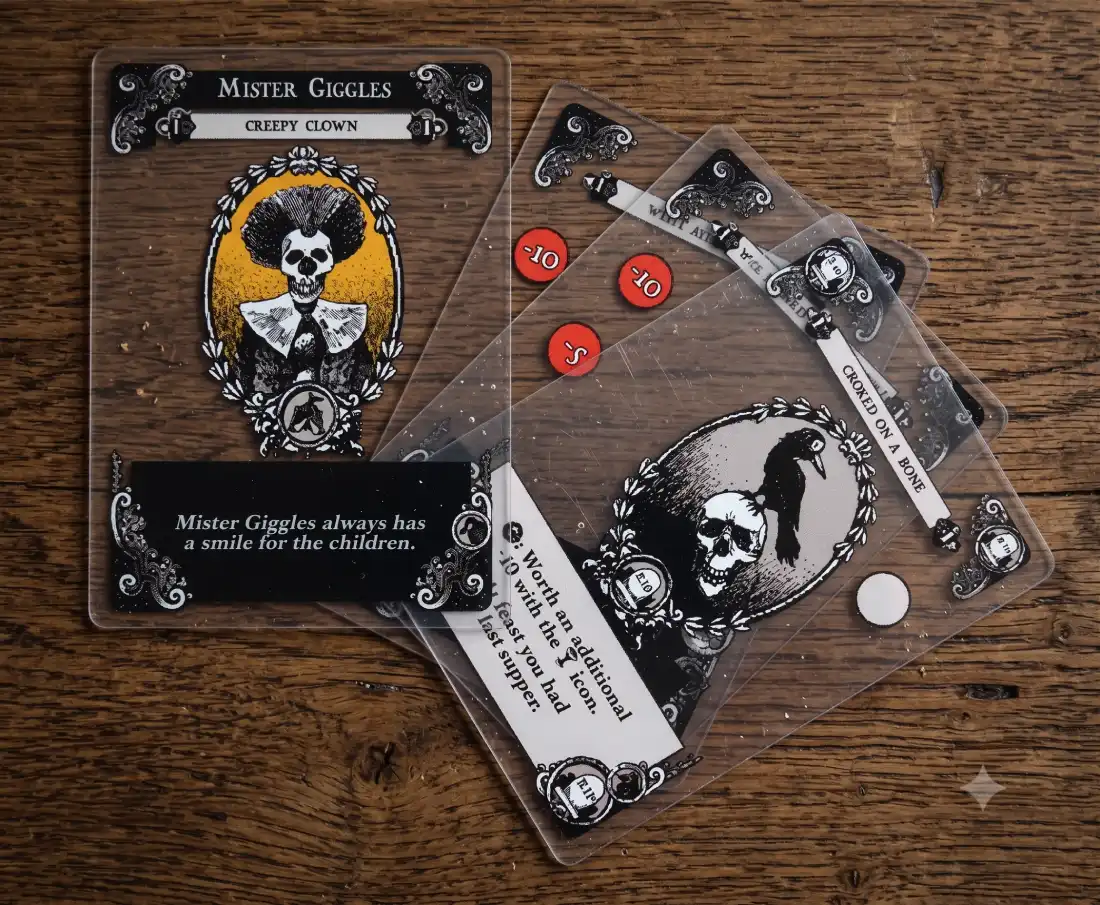
At a glance
- Players
- 2-5
- Play Time
- 1 hour
- Ages
- 13+
✓ What We Love
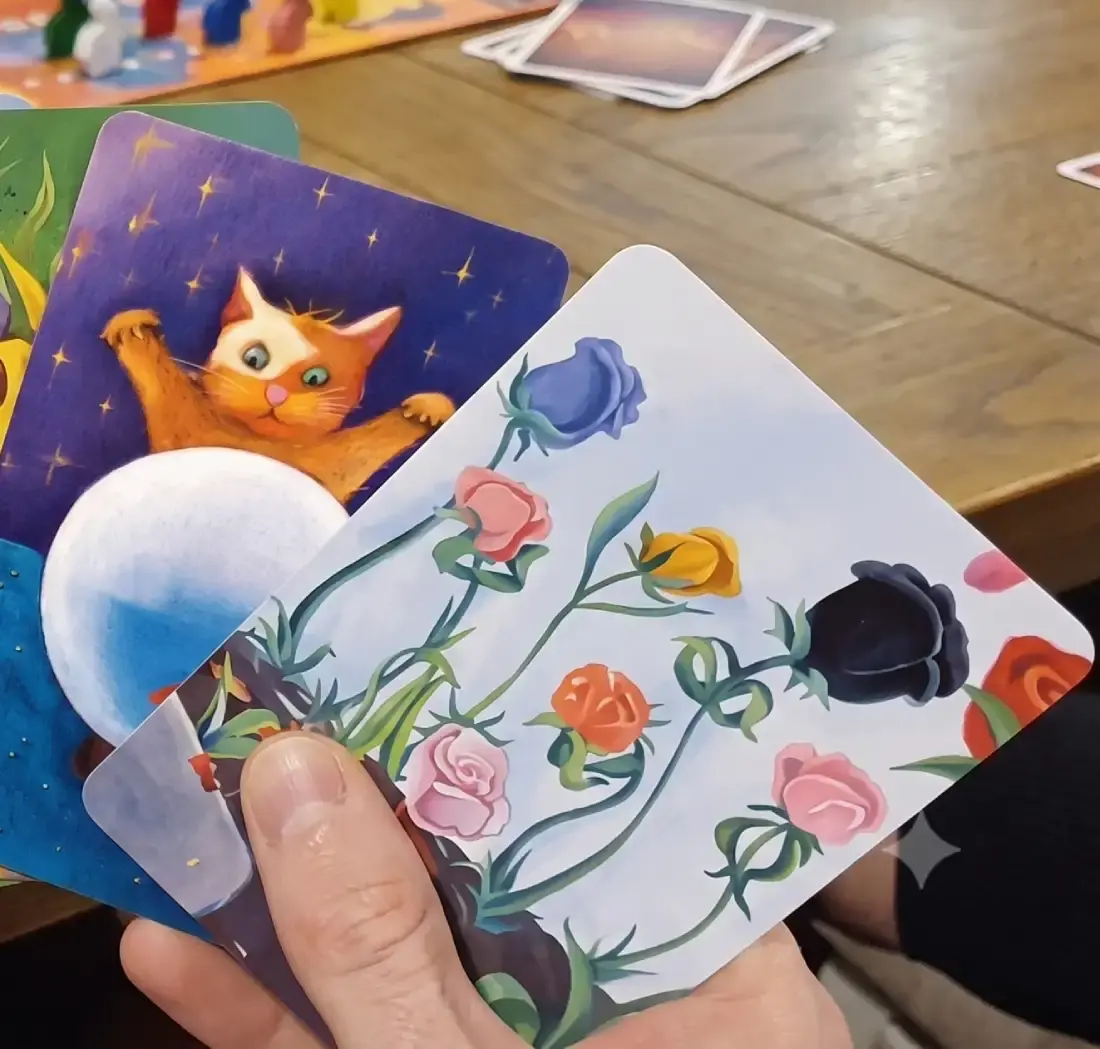
- •The card art and the card concept is amazing
- •The content of the cards is really funny
- •If played with motivated players, you will laugh a lot
✗ Could Be Better
- •You need commitment from the players
- •It is hard to understand since there are too many conditional cards
- •5 players is way too many for this game
About Gloom
Gloom hands you a rulebook that describes a perfectly ordinary card game, and then the actual experience has almost nothing to do with it. On paper you’re managing Self-Worth scores, stacking Modifier cards, and racing to kill off your family before your opponents kill theirs. In practice, none of that matters if you can’t improvise a decent story about why Great-Aunt Elissandre was trapped on a train.
I’ve watched this exact split happen at my own table. The mechanics are the scaffolding. The game is what your group builds on top of it, and that’s either the best thing about Gloom or the reason it never gets played twice.
Why Gloom Feels Like a Group Improv Exercise Wearing a Card Game’s Clothes
Strip away the storytelling and here’s what’s actually left: on your turn you make two plays, mostly stacking Modifier cards that add or subtract points, then draw back up to five cards and pass the turn. That’s it.
It’s a light, fairly abstract points game with a dark reskin, and if you play it that way, several of my sessions have confirmed exactly what you’d expect: it gets old fast. The rulebook itself all but admits this in its “For Beginners” section, which suggests new players just ignore card effects to learn the basics.
Ignore the effects long enough and you’ve ignored most of the actual strategy too.
The real game only shows up when someone commits to explaining every play out loud. Why was Helena trapped on a train? How did she meet the spouse she married while still imprisoned there? The rulebook’s own example follows that exact thread, and it’s not decoration, it’s the instruction manual for how you’re supposed to be playing.
The problem is that nothing in the rules enforces this. Storytelling is a request, not a mechanic, and the entire experience lives or dies on whether your table treats it as mandatory.
That’s why player count matters more here than in almost any other card game I review. Three players is the sweet spot in my experience, enough voices to keep the stories layered without any one person waiting too long for their turn. Four starts to push it, turns get longer, attention drifts.
Five works if everyone’s genuinely committed, using a scratch family built from the leftover characters after the four-player discard, but it’s asking a lot. And the single fastest way to kill the table isn’t a bad roll or a mistimed card, it’s one person who won’t play along. I’ve seen it happen exactly the way you’d predict: four people building an increasingly absurd tale, one person getting visibly impatient, and the whole thing deflating within twenty minutes.
Gloom doesn’t have a mechanism to route around a skeptic. It just needs one.
Gloom’s Scoring Doesn’t Matter, and That’s the Whole Argument
Here’s the part of the rulebook that trips people up if they read it too literally: the winner is whoever has the lowest total Family Value, calculated only from the visible Self-Worth points on their own dead characters.
Living characters contribute nothing. Your opponents’ dead characters contribute nothing to your score. You are purely optimizing for how miserable you can make your own family look on paper before they die.
Which raises the obvious question: if scoring is just arithmetic, why does everyone who’s actually played this game insist that winning is beside the point? Because the two ways people approach Gloom produce genuinely different experiences, and I don’t think either side is wrong.
Play to optimize your Family Value and you’ll do fine, stacking negative Modifiers on your own characters and positive ones on your opponents’, following the rulebook’s own guidance almost mechanically. Play to tell the best story and follow wherever the flavor text leads you, and you’ll often find the two goals pull in completely different directions, since the funniest narrative beat is rarely the mathematically optimal play.
I’ve sat at tables where the person telling the better story lost on points and didn’t care even slightly, and other tables where a quieter, more calculating player took the win everyone else forgot to chase. Both nights were fun. Neither table would agree on what “playing well” actually means, and I’ve stopped trying to reconcile that. It’s baked into the design.
The one thing I will say plainly: don’t take the scoring seriously enough to let it drive your plays. The moment Gloom becomes about winning the arithmetic, it turns into what it looks like on paper, a fairly repetitive stacking game, and you lose the entire reason to own it over something sharper and more strategic.
Is Gloom Worth It? Who Should Actually Buy It
Buy it if your group is the kind that leans into a bit, the kind willing to spend three minutes explaining exactly how Mister Giggles ended up trapped in a closet with Mister Eyeball Plucker. If that sentence made you grin, you already know whether this game belongs on your shelf, and it’ll fit right in with the rest of your party games collection.
It’s cheap, it teaches in five minutes, it travels well, and the transparent card mechanic alone is worth seeing in person even if you end up only playing it a handful of times.
Skip it if your group tends to play things straight, or if you’ve got even one person who’s going to sit out the storytelling and just move cards around. I’ve watched that single dynamic turn a genuinely clever game into a flat, forgettable one, and there’s no house rule that fixes a bored table. Skip it too if you want a game with real strategic depth.
Once you strip away the improv, there isn’t much underneath, and repeated plays without the storytelling wear thin fast.
One structural gripe worth setting expectations for before you buy: the game only ends once an entire family has died, and getting there can take longer than the rest of the experience earns.
If your table finds itself checking the clock in the back half of a game, don’t be afraid to house-rule an early ending, once a family crosses a set negative threshold rather than requiring every character to be dead. It tightens the pacing without touching anything that actually makes the game work.
📖 Rulebook
How to Play Gloom
Setup
- Separate the Character cards from the rest of the deck.
- Each player picks a family and takes its five Character cards, placing them face up on the table. Unchosen families are set aside for the game.
- In a four-player game, each player discards one of their own characters to keep the game from running long. For five players, build a new "misfit" family out of the leftover discarded characters.
- Shuffle the remaining cards (Modifiers, Events, Untimely Deaths) into a face-down draw pile at the center of the table.
- Deal each player a starting hand of 5 cards.
- Whoever's had the worst day goes first. If nobody can agree on whose day was worse, the game's owner starts. Play moves clockwise.
Your Turn
Every turn is two steps, always in this order:
- Make two plays. Each play can be any one of the following: play a Modifier card on any living character (yours or an opponent's), play an Event card and resolve its effect, play an Untimely Death card as your first play only, or discard your entire hand. You can also pass on either or both plays. Playing the same type twice is fine, except you can never play two Untimely Deaths in the same turn through your standard plays.
- Draw back up to your hand limit, normally 5 cards. If you're already above your limit, you simply don't draw. Then play passes to your left.
The Transparent Cards, Explained
This is the mechanic that sells the whole game, and it's worth understanding properly before your first play. Modifier cards are see-through. Stack a new one on a character and only the topmost, uncovered parts of every card underneath still count.
Cover a -15 with a +10 and the character's score shifts by more than just the new card's value, because you've also blocked the old one from counting. The same logic governs story icons and ongoing effects: if the text or icon is visible, it's active; if it's buried under a later card, it isn't.
That single rule, only count what you can see, is the entire engine of the game, and once it clicks, reading the table becomes genuinely satisfying.
The Untimely Death Rule Everyone Gets Wrong
You can only kill a character, yours or an opponent's, if their visible Self-Worth score is currently negative. A thriving, happy character is un-killable by design, which is exactly the reverse of what new players expect walking in.
It also means Untimely Death cards can only be played as your first move of the turn, unless a specific card effect grants you a "free play" that lets you sneak one in as your second.
Missing this rule is the single most common mistake I see at a first session, usually someone trying to mercy-kill a character who's still sitting on a positive score and getting stopped cold.
Winning
The game ends the instant the last living character in any single family dies. At that point, everyone tallies the visible Self-Worth points on their own dead characters only. Living characters count for nothing. Your opponents' dead characters count for nothing toward your total.
Whoever has the lowest Family Value, the most thoroughly ruined life on paper, wins.