+2
+2
Adds 2 straight to your final score. It never touches the sum of your number cards, and it can’t cause a bust.
Card 1 of 9Loading…
Want another card? You sure?
This one has had a real moment. It’s sitting near the top 50 of its category on BoardGameGeek despite a much more modest overall ranking, which tells you exactly what kind of hit this is: not a hobbyist darling, a genuine crossover party companion that ended up on tables that don’t normally have board games on them. The packaging brags it scales from 3 to 18 players. That figure gets repeated in every review, every unboxing video, every “is this worth it” thread. What almost nobody mentions is that it comes from one sentence buried in the rulebook: if you’re going past 18, grab a second set. That’s a clear logistics footnote, not an endorsement, and I’ve yet to see anyone who’s actually played an 18-person session say it worked the way the marketing implies.
Picture it for a second. A table of eighteen, one person dealing, one turn each, while seventeen others watch and wait to maybe bust. That’s not a celebration. That’s a very slow assembly line with snacks. The real game, the one people rave about, lives in a much narrower band than the marketing wants you to believe, and pretending otherwise does the pitch a disservice. Where it does land, reliably, is the messy middle: a family game night that can’t agree on anything heavier, or a friend group killing ten minutes while everyone else shows up.
Most reviews barely read the rules before moving on. Worth actually walking through them, because the parts most skip are exactly where the arguments start. You can learn the basic loop before the first hand is even dealt; it’s the specials that take an extra round to sink in.
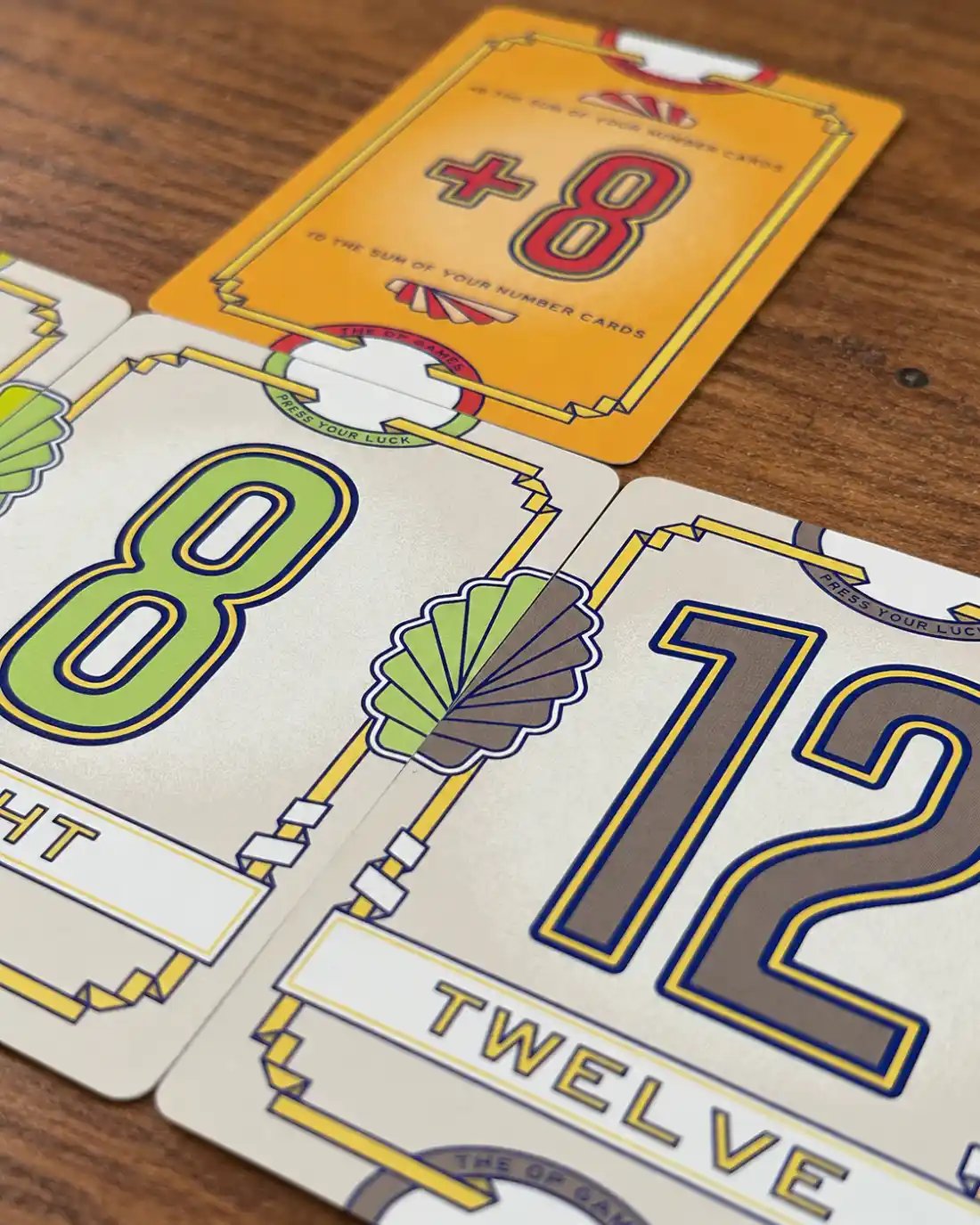
The deck runs 94 cards. Seventy-nine of those are numbered 0 through 12, and the quantity of each matches its value: a single 0, one 1, two 2s, all the way up to twelve 12s. On top of that sit six modifiers (+2, +4, +6, +8, +10, and an x2), and nine more split evenly across the action types, detailed below.
One player deals, going around the table one at a time until everyone’s holding a card face-up. From there, each player in turn chooses to draw another card or stay and bank what they’ve got. Pull a number you already hold and your round is over with nothing to show for it. That’s the entire game in one sentence, and it’s also why it teaches in about two minutes. Easy to describe, harder to master, which is exactly the split that keeps everyone coming back.
These are where the real decisions live, and where most newcomers get something wrong the first time:
Collect seven unique numbers in a single round without busting and you don’t get a choice about continuing. The round ends on the spot and you bank a 15-point bonus on top of everything else.
Scoring runs in a fixed order: add up your numbers, double that total if you’re holding the x2 modifier, then add any flat modifiers, then tack on the 15-point bonus if you earned it. First player to cross 200 points across as many rounds as it takes wins, and if two players clear 200 on the same round with matching scores, you keep playing until someone actually pulls ahead.
+2
Adds 2 straight to your final score. It never touches the sum of your number cards, and it can’t cause a bust.
Card 1 of 9 +4
+4
Adds 4 straight to your final score, on top of whatever your number cards add up to.
Card 2 of 9 +6
+6
Adds 6 straight to your final score. Stack a few of these and a modest hand turns into a big one.
Card 3 of 9 +8
+8
Adds 8 straight to your final score. Worth holding out for if you’re deciding whether to keep flipping.
Card 4 of 9 +10
+10
The biggest flat bonus in the deck. Adds 10 straight to your final score.
Card 5 of 9 x2
x2
Doubles the sum of your number cards only, before any +X modifiers get added. Early in a round it doubles a small total. Late in a round, after a strong run, it doubles a huge one.
Card 6 of 9 Flip Three
Play it on any active player, yourself included. That player draws three cards in a row, one at a time, with no choice to stop partway through. A duplicate number anywhere in those three still busts them.
Card 7 of 9 Freeze
Play it on any active player. They have to stop immediately and bank whatever score they’ve built so far, whether they were ready to stop or not.
Card 8 of 9 Second Chance
Keep this in front of you until you need it. The next time you’d draw a number you already have, discard the duplicate and this card instead of busting. You can only hold one at a time.
Card 9 of 9Portability is where it earns its keep. It's small, the whole kit disappears into a backpack, and setup is close to zero. The deck itself feels sturdy in hand, with clean numbering and specials that are easy to spot at a glance even in a crowded round, which matters when kids are the ones doing the shuffling.
The one gripe worth raising: the tuck box doesn't hold up to the travel life the game is sold on. If you're cycling this through cabin trips and carry-ons the way every review suggests, budget for a zip bag or a sturdier case within a few outings, because the stock packaging tears faster than it should.
Here's where the count question actually gets interesting, because the honest range isn't 3 to 18. It's closer to five through nine. Below that, the smart move is folding early almost always, which quietly kills the exact tension on offer.
This is push-your-luck stripped to its studs: fold too early and it's boring, push too far and you torch the round. Above roughly ten, you start losing the room.
Group games in general lean this way once the table gets too big. Someone's on their phone, someone's had a drink too many to track the running total, and suddenly the dealer is the only person actually paying attention. It's an easy travel pick for exactly that reason: quick enough to toss in a bag and fit between dinner and dessert, which is why it keeps landing at family gatherings that don't have room for a three-hour strategy game.
When the gameplay clicks, it's genuinely fun. Every turn gets a reaction. Onlookers who aren't even in the round will lean in and start coaching whoever's on the edge of busting to go for one more, and there's a genuine little thrill in either pulling it off or torching your whole round in front of everyone.
Whoever busts doesn't check out either, they stay locked in, coaching from the sidelines while the rest of the table keeps playing. That's the case for the game, and it's real. The counter-argument is just as real: there's so little actual strategy or decision-making that you could hand your turn to the person next to you and step away without missing anything that matters.
There's one thin skill lever underneath all that randomness: keep a mental tally of which low numbers are already gone, and you can tell when staying in gets meaningfully safer than the table around you realizes. It's a rounding error next to real decision-making, but it's there, and the sharpest person at the table is usually the one quietly doing that math while everyone else is just guessing how many points they're risking. Whether that reads as relaxing or hollow depends entirely on what you want out of a card game.
Uno is the comparison everyone reaches for, and it wins that matchup easily on tension and pacing. The push-your-luck gameplay gives every turn actual stakes in a way Uno's card-dumping never quite manages. But Uno isn't really the honest comparison.
It's actually competing with the other small-box, five-minute-teach titles: No Thanks, 6 Nimmt, Skyjo, Pairs.
Against that field, it doesn't win on originality. It's a Blackjack hit-or-stand decision with two extra rules bolted on, and it plays like a close cousin to older risk-and-hold designs such as Pairs, which ran the same collect-without-repeating premise well before this one showed up with better production values behind it.
What actually sets it apart from that whole shelf is the take-that layer: Freeze and the forced-draw redirect add real opponent-facing chaos that pure risk designs like No Thanks don't have, which is the specific ingredient that makes it play louder and meaner than its influences.
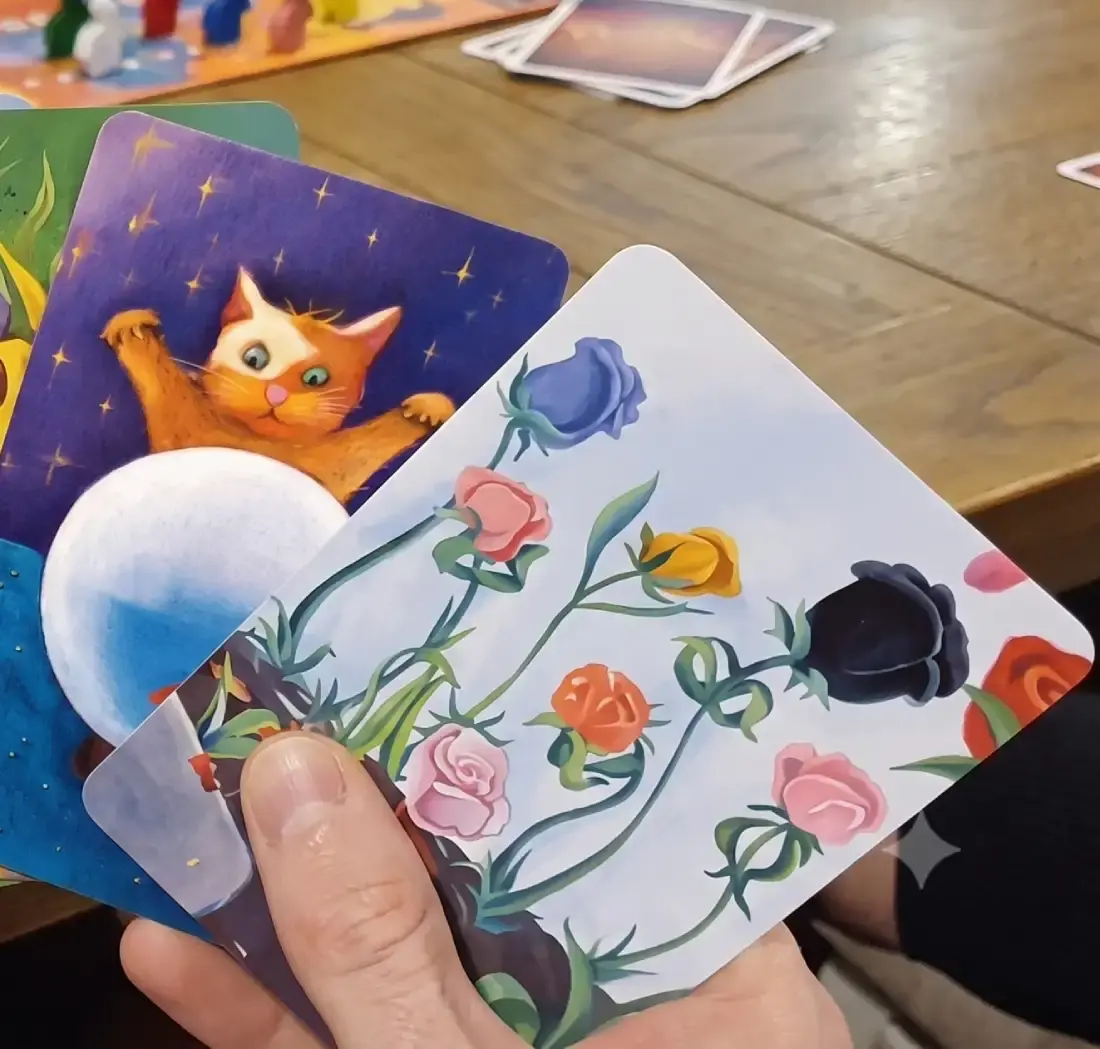
If your shelf already has Dixit for a slower, funnier alternative, it fills the other end of that gap: quick, loud, and done before anyone's second drink.
Card table showdown
One game has been the default deck in every junk drawer for fifty years. The other went from nowhere to the table at every game night in a single year. Here is how they actually compare, card for card.
Both games are quietly built around the same number. Uno deals seven cards to start every hand, before anyone has made a single decision.
Flip Seven takes its name from the other end of the same idea: collect seven unique numbers before you bust, and the round ends in your favor with a bonus on top.
The table spans generations, nobody wants to learn anything new, and the group has patience for a match that runs until someone hits 500.
The group is bigger than a card table usually allows, rounds need to move fast, and the fun is in deciding whether to stop.
Neither game is trying to replace the other. One is the deck everyone already owns; the other is the one everyone is still learning to stop pushing their luck on.
The version sitting on shelves right now is labeled 2nd Edition. It's the same 94-card release described above, sold direct from The Op, and it's picked up real hardware since launch: a 2025 Spiel des Jahres nomination and Party Game of the Year at the Golden Geek Awards. If someone's asking whether the "2nd Edition" tag means the rules changed, it doesn't, it's a reprint designation, not a redesign.
What did actually change the formula is With a Vengeance, a standalone 2026 sequel rather than an expansion, with enough new content to feel like a genuinely different game. It ships with 108 cards, sold direct from The Op, and swaps in sharper specials, think steal, force-draw, and score-slashing effects, plus negative modifiers that can actively knock your total down.
If the "there's barely a decision here" criticism above is the thing holding you back, Vengeance is the version built to answer it. It's currently the harder copy to find outside Walmart and select retailers, so check local availability before assuming it's sitting next to the 2nd Edition on the shelf.
Early reviews of With a Vengeance are still thin this early into its first month on shelves, so temper expectations until more groups have actually put it through its paces.
| 2nd Edition | With a Vengeance | |
|---|---|---|
| Deck Size | 94 | 108 |
| Players / Age | 3+ / 8+ | 3+ / 8+ |
| Core change | None, same base ruleset | New take-that specials, negative modifiers |
| Best for | First-timers, casual and family groups | Groups who found 2nd Edition too passive |
You'll find either one at a local hobby shop or general retailer without much hunting, no exclusive online storefront to chase down. It also has a free companion scoring app and a playable version on Board Game Arena if you want to try before you buy a physical copy.
Age 8 and up is the official line, and that tracks. What that line doesn't quite capture is that the real decision-making, tracking which low numbers are already gone, weighing whether to push past six, skews older than eight.
Kids that young are mostly running on instinct, which is honestly half the charm of watching them do it, but the adult quietly counting along at the same table is getting a meaningfully different game out of the same rules. Watch a table spanning several ages in the same round and the split is obvious: the youngest kids are flipping on pure gut feeling, and everyone older is quietly doing the same math at different speeds.
This is textbook gateway territory too, the exact kind of low-commitment title the hobby uses to rope in newcomers of all ages who don't own a single board game yet. Where I'd push back on the usual pitch is the framing that this is something you build a night around. It isn't, and treating it like one sets you up for disappointment.
This is a suitcase game, built more for travel than for anchoring a big night in. It's the thing you pull out while you're waiting for the rest of the group to show up, or the one that gets requested every Thanksgiving specifically because your extended family, all different ages, doesn't want to learn a rulebook, just something fun and fast. Each round runs a quick 20 minutes, which makes it easy to sneak in another game before the night really starts, but easy to sneak in isn't the same as essential.
Teaching it is genuinely painless once you've played a round yourself. The rules are intuitive enough that the Second Chance cards feel like a safety net rather than a crutch, and everyone's usually up to speed after one quick lap around the table.
If you need a low-stakes opener or a palate cleanser between heavier titles, or just something a mixed-age family can pick up without a rules debate, it does that job better than almost anything else on the market.
Draw one at a time and try to collect seven unique numbers without repeating one. Duplicate a number and you bust, losing everything you'd banked that round.
Actions and modifiers layer extra risk and reward on top; read the full breakdown above.
Each turn you choose to draw again or stay and lock in your current total. That single decision, repeated every round until someone crosses 200 points, is all there is to it.
The Freeze and Flip Three action cards. Plenty of games run the same collect-without-busting premise, but few let you actively force a rival into a bad position the way it does.
Two, in different senses. The 2nd Edition on shelves now is a reprint of the original ruleset.
Flip 7: With a Vengeance, released in 2026, is a standalone sequel with genuinely new mechanics rather than an updated version of the same game.
It delivers exactly what it promises: fast, cheap, social, fun, and about as easy to teach as a card game gets. The action cards do real work keeping rounds from feeling identical, and the moment-to-moment tension of one more card or bank it is legitimately addictive in the right group.
The honest downside is that it leans heavily on chance dressed up as a decision. If you want a card game with real strategic weight, this isn't it, and no amount of Second Chances changes that. Replay value is genuinely split in a way most reviews gloss over: it doesn't ask for much money and the content itself never changes round to round, so it's cheap enough that people keep giving their copy away and buying another, but plenty of regular game-night groups get about a month of steady rotation before the novelty of Blackjack-but-simpler wears off and it gets shelved.
For a first purchase, get the 2nd Edition. It's about as good a money-to-entertainment ratio as this hobby offers on a budget, which makes it a low-risk call either way.
If your group already owns it and found the original too passive, With a Vengeance is the upgrade path built specifically for that complaint. It isn't going to replace your favorite heavy strategy game, and it was never trying to. Buy it for what it actually is: a cheap, fun, portable icebreaker for five to nine players that's better at closing out a night than headlining one.
Most reviews barely read the rules before moving on. Worth actually walking through them, because the parts most skip are exactly where the arguments start, and at least two of them change how you should actually play.
The deck runs 94 cards. Seventy-nine of those are numbered 0 through 12, and the quantity of each matches its value: a single 0, one 1, two 2s, all the way up to twelve 12s. On top of that sit six modifiers (+2, +4, +6, +8, +10, and an x2), and nine more split evenly across the action types, detailed below.
Setup is where the first surprise lives. The Dealer deals one card face-up to everyone, including themselves, in turn order, but if an action card comes up mid-deal, dealing stops right there to resolve it before continuing.
That means it's entirely possible to sit down with three or four cards already in front of you before your own first turn even starts, while the person next to you is still waiting on their one card. Once everyone's dealt in, the rulebook actually borrows Blackjack's own language for what happens next: each player chooses to "Hit" (take another card) or "Stay" (bank what they've got and step out). Pull a number you already hold and your round ends with nothing to show for it.
These are where the real decisions live, and where most newcomers get something wrong the first time:
You cannot bust on a Modifier card, only a duplicate Number card ends your round. You can technically stay with nothing but a Modifier or two and no numbers at all, and you'll still score those points, with one exception: an x2 on its own scores zero, since there's nothing underneath it to double.
Collect seven unique numbers in a single round without busting and you don't get a choice about continuing.
The round ends on the spot and you bank a 15-point bonus on top of everything else. Scoring runs in a fixed order: add up your numbers, double that total if you're holding the x2 modifier, then add any flat modifiers, then tack on the 15-point bonus if you earned it. Here's the piece the box copy glosses over: hitting 200 points doesn't end the game mid-round. The round always plays out to its natural finish first, everyone busts or stays, or someone flips seven, and only after that round's scores are added up does anyone check who's crossed 200. Whoever has the highest total at that point wins, which in a close game isn't automatically the player who happened to cross the line first.
Worth knowing if you're the type who tracks cards: the deck doesn't reshuffle between rounds.
Cards from a finished round get set aside as discards, and the same shrinking deck keeps getting dealt from until it actually runs out, at which point the discards get shuffled back in. If you're keeping a mental tally of which low numbers are already gone, the deck gets more readable, not less, the longer a fresh shuffle stays in play.
Ages 8+
Pick a card, don't be obvious.