Loading…
Vicious Gardens
Your garden. Their problem.
3.6
(0 reviews)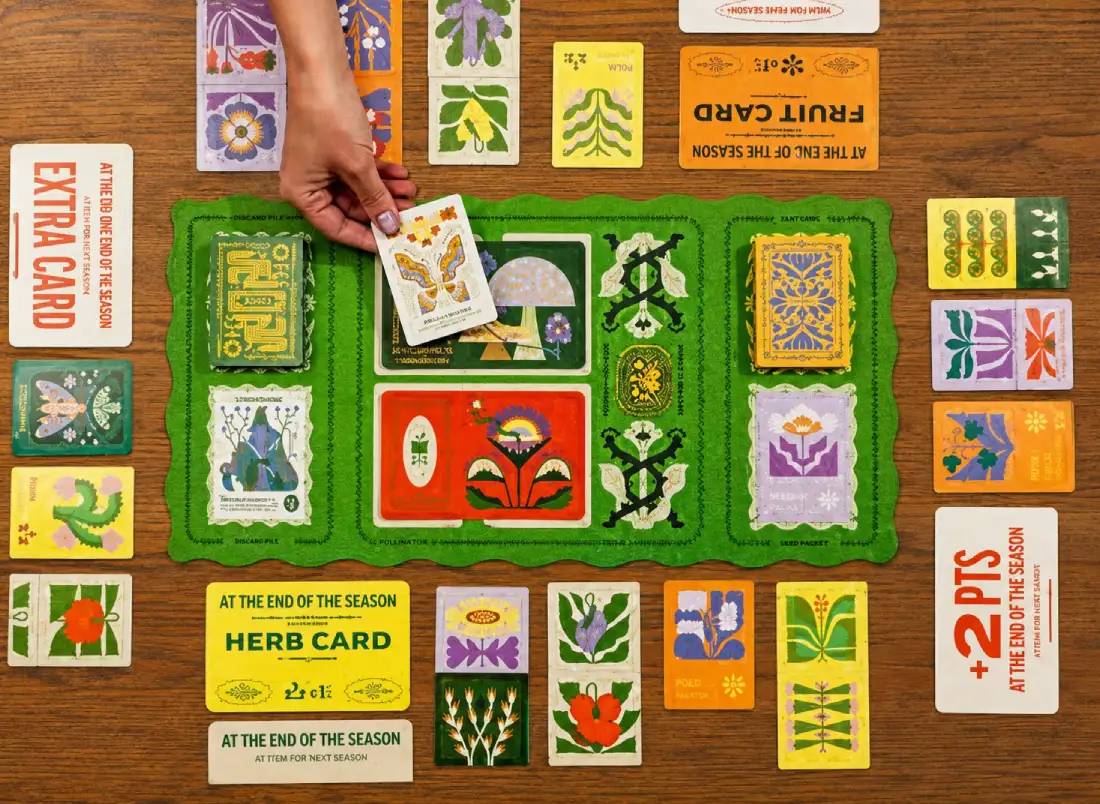
At a glance
- Players
- 1-6
- Play Time
- 20-45 min
- Ages
- 10+
✓ What We Love
- •The game art is beautiful
- •Easy to teach, it's not overwhelming
- •You feel like you are doing something in every turn
- •It already has expansions in case you liked this game
✗ Could Be Better
- •Two player game is kind of bland
- •It can drift into parallel solitaire if the players aren't attacking one another
- •The game can end fast
- •Experienced players may find it boring
About Vicious Gardens
I’ll get the obvious out of the way: Vicious Gardens is one of the most beautiful things Ross Bruggink has ever put on a table, and he also designed the current Minnesota state seal, so that’s saying something. But is the art distracting us from the game? Let’s find out.

The plants have weird crazy names like Fuzzlesquash and Floofberry. The boards are functional and lovely in equal measure. I bought in on the art as soon as I saw the Kickstarter video, before I even knew the rules, and I don’t regret it.
What I do feel, sitting with it after a few plays, is something close to mild disappointment. Don’t get me wrong, it’s fine, I don’t have buyer’s remorse, I just feel that the game is missing something, it’s not mean, but it’s not nice, it’s just, putting it in plant terms, a ficus?
What Vicious Gardens Actually Is
You’re a competitive gardener, which is already funnier than most game premises. Each turn you pot plants from your hand into one of four plots on your personal board, harvest them to pay for powerful Victory Cards and Specialist helpers, then draw back up to five. First gardener to claim three Victory Cards triggers the end of the season, everyone gets one more turn, and whoever has the most points wins.
Victory Cards are worth 8 points each. Individual plants score 1. The gap between those two numbers is basically the whole game — you’re spending cheap plants to buy expensive cards while trying to stop the people across the table from doing the same thing faster. The Specialists are where it gets interesting: most of them make you sacrifice plants from your own garden to activate, which creates a constant tension between hoarding for points and spending for power. That cost-and-effect loop is the sharpest mechanical idea in the box.
The sabotage layer runs on 2 tools. Pestilence poisons a rival’s plot or Victory Card, a poisoned plot can’t be harvested and scores zero. You don’ want those cards in your garden. But, since they will come out, you need a Pollinator. This card shields your own garden from attack, and nothing can land on a Pollinated plot except the Beebeard Specialist, which exists specifically to rip protection off. Layer in Specialists that swap plots between players, steal plants outright, or trade Victory Cards, and on paper this is a game built around ruining each other’s afternoons.
Where Vicious Gardens Pulls Its Punches
Here’s the thing: the attacks don’t land hard enough.
Pestilence poisons a plot. Your opponent loses that plot’s harvest potential and its end-game points — which sounds significant until you realize they can just work around it and keep building elsewhere. A Pollinator costs you a turn to place but doesn’t guarantee your rival spent a turn dealing with it. The Specialist that steals plants lifts them out of a garden that was going to be harvested for coins anyway. Effects that look vicious on the card resolve as mild inconveniences at the table. This is something that is also a pain point in Villainous, you can have 3 heros on your board and still win a game. This can be good or bad, depending if it’s you winning, but, still, you want cards to really ruin a game for your rivals. It’s more fun.
The game is afraid to fully let players loose on each other. You get 20 to 30 minutes of pleasant chaos, you get punched a few times, you punch back a few times, and then someone tips over the finish line and wins by a small margin that never quite felt decisive. The escalating point swings near the end give the game its best moments, but they arrive too briefly and too late.
The win condition adds to the problem. You can’t control which plants you draw, and the Victory Cards rotate randomly, so it’s not uncommon to watch someone claim a card, see the replacement flip, and immediately watch the next player take it with plants they were already holding. You could play your turns without looking at the table between them and not be that much worse off. For a game that sells itself on interaction, that’s a real flaw.
The Specialists Are the Game
This is the thing I wish the box led with. The plants are a resource. The Victory Cards are the win condition. But the Specialists are where Vicious Gardens actually lives.
Knowing when to burn a Specialist versus when to save your plants for a Victory Card is the real decision engine. The ones that demand specific plant types to activate push you toward building deliberately rather than grabbing whatever you draw. Beebeard — the only card that can strip a Pollinator — becomes a priority target the moment anyone starts shielding aggressively. Mother Nature’s plot-swap can flip the game’s point standings in a single turn. These aren’t mild setbacks. These are the moments people remember.
The gap between the Specialist ceiling and the rest of the game’s power level is wide enough that I’d genuinely recommend leaning hard into the Specialist deck when you’re learning. Draw heavy on Specialists early. The plants are fine. The gardeners are the game.
Is Vicious Gardens Worth Buying?
Yes, with one “but”.
If you want a light, fast take-that card game that looks incredible on the table and teaches in five minutes, Vicious Gardens delivers. It plays in 20 to 30 minutes, works from two to four players, and has enough genuine nastiness to keep the table engaged.
It has 2 expansions: The Chaos Critters and Fancy Plants that can add more “spice” to the game in case you play it too much.
The “but”: If you want a game that genuinely stings, that produces the table-flipping moments the premise threatens, you might finish your first play wondering when the real teeth show up. They’re there but it’s not vicious like the title implies.
Designed, written, and illustrated by Ross Bruggink, published by Atlas Games in 2025. It funded past half a million dollars on Kickstarter and earned every dollar of that on the strength of the art alone. The gameplay mostly keeps up.
📖 Rulebook
How to Play Vicious Gardens
Setup
- Shuffle the Plant, Specialist, and Victory Card decks separately. Split the 14 Victory Cards into two face-down piles of 7 and place them within reach of all players.
- Place the central board in the middle of the table. Each player takes a personal garden board and places it in front of them.
- Each player draws 3 Plants and 2 Specialists for a starting hand of 5 cards.
- Whoever most recently killed a plant goes first. Play proceeds clockwise.
On Your Turn
You may plant and harvest in any order, as many times as you like, then resupply.- Plant. Play Plant cards from your hand face-up into your garden, sorted into their matching Plot by category: Fruit, Produce, Flowers, or Herbs. Each Plant scores 1 point at the end of the game.
- Harvest. Discard Plants from your garden to the Compost Pile to pay costs. You never harvest from your hand. You harvest for two reasons:
- Victory Cards: pay the Plants shown on the card, then flip it face-up into your garden. Worth 8 points each, plus a bonus ability that is now yours.
- Specialists: most require harvesting one or more Plants to activate their effect, then go to the Retired Pile.
- Resupply. Draw from the Plant and/or Specialist decks in any combination until you hold 5 cards. You may discard one Specialist before drawing. Your turn ends.
Sabotage Tools
- Pestilence: Place on any rival's Plot or Victory Card. An afflicted Plot cannot be harvested and scores 0. An afflicted Victory Card keeps its 8 points but loses its bonus ability.
- Pollinator: Place on your own Plot or Victory Card to protect it. Nothing can target a Pollinated card except Beebeard.
- Beebeard: The only Specialist that can remove a Pollinator from a protected card.
Key Specialists
- Mother Nature: Swaps two matching Plots between players.
- Landscaper: Steals a Plant directly from a rival's garden.
- Hareman of the Gourd: Forces a Victory Card trade between players.
Scoring
Points are totalled when the season ends:| Item | Points |
|---|---|
| Victory Card | 8 + bonus ability |
| Each Plant or Wild Bloom | 1 |
| End of Season Token | 1 per player at the table |
| Bird Bath | Doubles the Plot it sits in |
| Afflicted Plot | 0 |