In this article
We got sharks before the Shoebill. Stonemaier has explaining to do.
Let’s be entirely honest with ourselves for a moment. We need to talk about the massive, featherless elephant in the birdwatching room, or if you want, picture an elephant with tiny wings, that is also cool.
Stonemaier Games recently updated their product roadmap, and once again, the African continent has been completely, inexplicably left out.
Instead of giving us the Maasai Mara, the Congo basin, or the rich wetlands of the Okavango Delta, what did we get? We got the Americas Expansion, which, I know, America is an amazing nature filled continent, we got the hummingbird, and hummingbirds rock, credit where credit is due, the expansion is fantastic. The hummingbird overlay track is an amazing mechanical twist, and the card art is gorgeous like always.
But that’s not the point, it wouldn’t be a rant if this were the point. But when they released the calendar, I found an expansion for Finspan, really? Finspan? We are literally getting a standalone game about sharks, coral reefs, and marine biology before we get a single African avian species. And please, let’s not argue if sharks are cooler than birds, because, yes, they probably are, but can sharks fly? Can you imagine sharks flying? Ok, getting off topic.
We are getting literal fish before we get the most mechanically rich, aesthetically striking, and historically significant bird continent on the planet.
According to the official Stonemaier pipeline tracker, Wingspan Expansion 5 is listed as “in the design and art phase” with an unannounced launch date. We all know what that means in board game publishing lingo: Africa is being held hostage until at least late next year, if not further out. Not cool, Stonemaier, not cool.
Wingspan Africa Expansion Gameplay: New Board Game Mechanics We Desperately Need
The most frustrating part of this delay isn’t just that we want pretty new cards to look at (but also yeah), it’s that the African ecosystem offers a goldmine of mechanical innovation that Wingspan desperately needs to keep the engine-building genre fresh and fun.
Every previous expansion brought a distinct structural shift to the table: Europe introduced end-of-round powers, Oceania revolutionized the economy with nectar and flightless bird bonuses, Asia gave us the brilliant Duet mode for couple play, and the Americas introduced the hummingbird infrastructure, already mentioned but, you can never have enough hummingbird mentions. That is a bird fact.
Africa has the potential to introduce mechanics that could fundamentally redefine how we interact with the board and each other. Here is what Stonemaier is leaving on the table while they design fish cards:
1. Mega-Eggs and Communal Nesting
Africa is home to extreme avian architecture and biology. Consider the Social Weaver. These tiny birds build massive, multi-generational communal nests that look like giant haystacks dropping out of acacia trees. They house hundreds of birds at once, like those apartment buildings in Hong Kong.
In Wingspan, this could easily translate to a Communal Nest Overlay. Imagine playing a Weaver card that allows you to tuck other birds underneath it to expand its nest capacity, or a mechanic where adjacent cards in a habitat can share egg tokens.
On the other end of the spectrum, we have the Ostrich—the undisputed heavyweight champion of the avian world. We don’t just need a regular egg on an Ostrich card; we need a Mega-Egg token. A token that takes up two standard nest slots on a playmat but yields triple the end-game victory points, creating a high-risk, high-reward strategy for players focusing on the Grassland habitat. As a tribute to the poor bird that has to lay that egg.
2. The Great Seasonal Migration Tracker
One of the most defining ecological features of the African continent is the massive, sweeping migration patterns driven by wet and dry seasons.
Currently, Wingspan is a relatively static game. Once you place a bird in a habitat, it stays there unless a very specific, rare card power allows it to migrate to an adjacent row.
An Africa expansion could introduce a shared, central Climate and Migration Board. As rounds progress, the “rains” move, shifting the global bonuses or changing the resource costs of specific habitats. Certain African migratory birds wouldn’t just sit in your Forest; they would actively shift to the Wetlands or the Grasslands depending on the global weather tracker, forcing players to dynamically pilot their engines rather than relying on the same repetitive action sequence every single turn. Wow, I am getting excited just thinking about this, for this I would wait, see?
Best Wingspan African Bird Cards: 4 Species Ready to Ruin Your Friends’ Strategy
The internet is filled with fan-made card designs, and the consensus is clear: the community wants the heavy hitters, and they want them to feel as powerful and unique as their real-world counterparts. If and when Stonemaier finally delivers this expansion, these four birds need to lead the pack, and their card powers need to be absolutely metal.
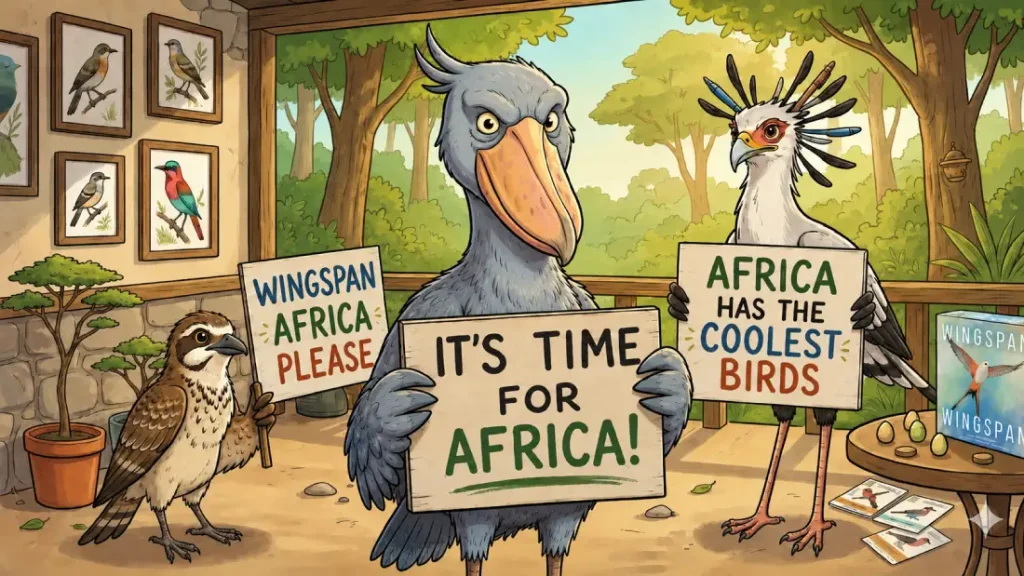
The Shoebill Stork: The Ultimate Intimidation Engine
Look at a Shoebill Stork and tell me it isn’t a dinosaur. It stands five feet tall, has a beak shaped like a Dutch clog, and stares with an unblinking, prehistoric gaze that can terrify apex predators. It literally eats baby crocodiles for breakfast. Google it, I dare you, it’s scary, and have you heard the sound it does? Incredible. And actually, it’s not a stork.
- The Desired Power: The Shoebill cannot just have a standard “roll a die, see if you get a fish” predator power. It needs a brutal, psychological Pink Power (Opponent’s Turn). When an opponent activates a hunt power or gains a fish resource, the Shoebill triggers, forcing that player to reveal their hand and allow you to discard a card of your choice out of pure intimidation. It should be the ultimate counter to card-hoarding strategies.
The Secretary Bird: The Serpent Slayer in High Heels
The Secretary Bird looks like a high-fashion supermodel, but it makes its living by walking through the savanna and stomping venomous snakes to death with a force five times its own body weight. It is an absolute assassin.
- The Desired Power: A specialized hunter mechanic. Instead of checking the bird deck for a small rodent symbol, the Secretary Bird should interact directly with the food supply. A Brown Power (When Activated) that allows you to convert any rodent or reptile food token in the global birdfeeder directly into a massive 3-point cache on the card, clearing the feeder and forcing your opponents to reset their resource plans.
The Greater Honeyguide: The Symbiotic Trader
The Honeyguide is famous for its literal partnership with humans and honey badgers. What’s not to love? It cannot break into a beehive on its own, so it flies around, finds a mammal, makes a distinct calling sound to guide them to the hive, waits for the mammal to bust it open, and then swoops in to eat the leftover wax and larvae.
- The Desired Power: This card screams for a cooperative, table-wide trade mechanic—something Wingspan has experimented with but never perfected. When activated, you and an opponent of your choice both gain an invertebrate token from the supply, but you get to draw a card from their hand or the face-up tray as a “finder’s fee.” It introduces politics to a game that is traditionally played in solo silos.
The African Sacred Ibis: The Mythological Engine
Steeped in ancient Egyptian lore as the living embodiment of the god Thoth, the patron of wisdom and writing, the Sacred Ibis is historically iconic.
- The Desired Power: This should be a Yellow Power (Game End). True to its association with wisdom and recording history, the Ibis could score bonus points based on the variety of different nest types present across your entire reserve, or grant points for every fully completed column on your player mat, rewarding a balanced, intellectual approach to grid-building.
African Birds Expansion Speculation Matrix
| Avian Species | Real-World Ecological Niche | Predicted Gameplay Mechanic |
|---|---|---|
| Social Weaver | Builds massive, multi-generational communal hay nests. | Multi-card overlay that shares egg resource capacities across rows. |
| Ostrich | Lays the largest eggs on the planet. | Exclusive 3VP “Mega-Egg” token that occupies two mat spaces. |
| Greater Honeyguide | Guides mammals symbiotically to wild beehives. | Cooperative resource trading introducing table politics. |
| Secretary Bird | Stomps venomous snakes to death in high heels. | Feeder starvation mechanics by aggressive rodent caching. |
Wingspan Expansion Tier List: Why Stonemaier Games Needs to Prioritize the Savanna
Look, let’s be realistic. Elizabeth Hargrave has created one of the greatest modern board games in history. The ecosystem of Wingspan is a masterpiece of game design, blending educational taxonomy with tight, satisfying engine-building.
And yes, when the lightweight standalone version comes out, I will buy it. When the shark-themed marine expansion drops, I will absolutely buy that too, because I am weak and my completionist brain demands a full Nesting Box.
But Stonemaier, please. Stop teasing us with fan surveys and regional queries. Stop making us wait while we watch other niche spin-offs take center stage.
Give us the sweeping savanna, give us the brutal predators, give us the migratory weather tracks, and let us finally play a Shoebill Stork to completely ruin our friends’ day. It is time to bring Wingspan home to the richest bird continent on Earth.