In this article
Crowdfunding completely decentralized the tabletop gaming industry.
There was a time when the tabletop gaming industry was tightly controlled by an elite group of traditional publishers. If a designer had a brilliant, quirky, or avant-garde game concept, they had to pitch it to executives, navigate corporate gatekeeping, and hope a company was willing to risk millions of dollars on printing and distribution.
Then came Kickstarter.
The crowdfunding revolution completely decentralized the industry, turning everyday gamers into venture capitalists. It allowed weird, niche, and highly ambitious designs to bypass the traditional pipeline and go straight to the people who would actually play them. While thousands of projects have launched on the platform, a select few didn’t just meet their funding goals—they exploded into massive international phenomena, forever changing the landscape of modern board gaming.
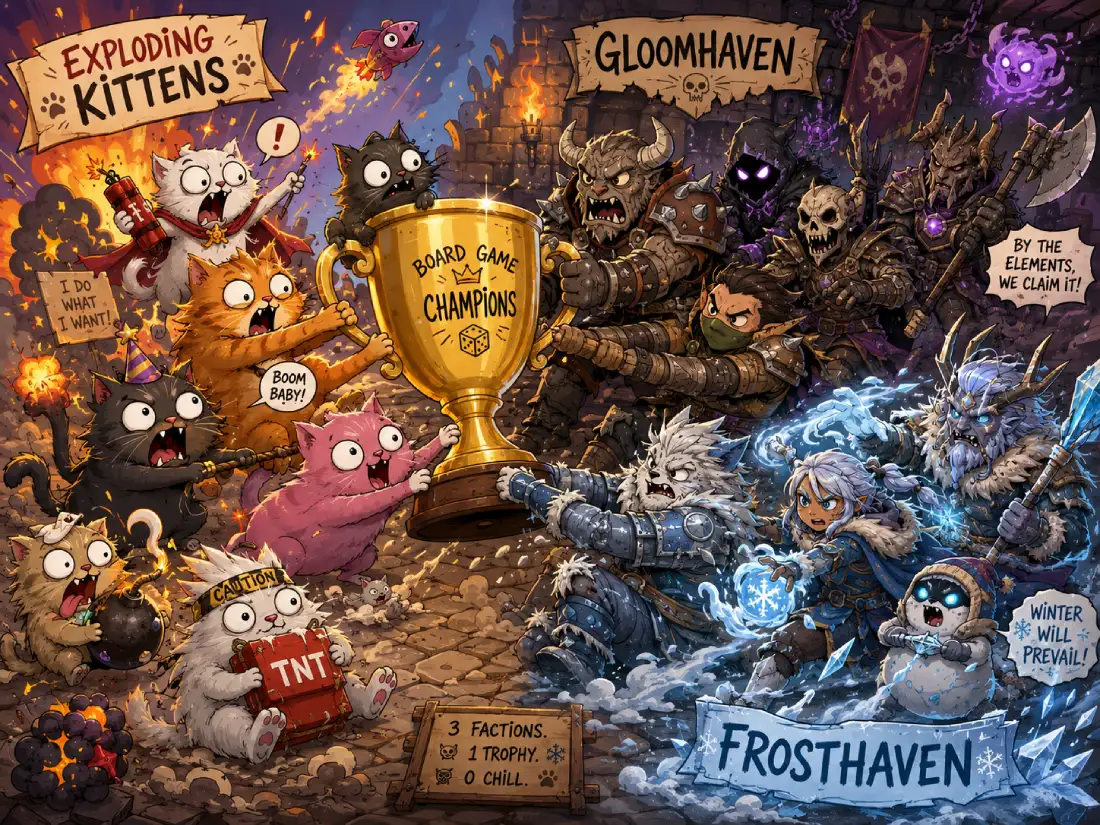
Here is a deep-dive look at three legendary Kickstarter campaigns that turned indie dreams into global tabletop empires.
1. Exploding Kittens: The Viral Masterclass in Strategic Simplicity
In 2015, a project hit Kickstarter with a deceptively simple premise: it was essentially Russian Roulette, but with weaponized, hyperactive felines. Created by Elan Lee, Shane Small, and Matthew Inman (the creative mind behind the wildly popular webcomic The Oatmeal), Exploding Kittens became an instant masterclass in how to leverage internet culture and viral marketing into crowdfunding gold.
| Campaign Metric | Exploding Kittens Statistics |
|---|---|
| Initial Funding Goal | $10,000 |
| Total Amount Raised | $8,782,571 |
| Total Backers | 219,382 backers |
The Secret to Its Massive Success
The campaign reached its modest $10,000 goal in just eight minutes. By the time the campaign closed, it had shattered records to become the most-backed Kickstarter project in history at the time.
The secret was accessibility wrapped in relatable, internet-friendly humor. While hardcore gamers were busy backing complex miniatures games, Exploding Kittens targeted the casual market. It was a fast-paced party game that anyone could learn in two minutes, but it possessed just enough take-that strategy—using Defuse cards, See the Future cards, and forced phase skips—to keep people coming back.
Today, Exploding Kittens is a household name, lining the shelves of major retail giants globally, and has spun off into an entire ecosystem of expansions, mobile apps, and merchandise.
2. Gloomhaven: Dismantling the Traditional Retail Paradigm
If Exploding Kittens captured the casual party crowd, Isaac Childres’ Gloomhaven did the exact opposite: it took the hardcore, dedicated euro-gaming community by absolute storm. Launched in 2015 with a modest initial print run, this massive, twenty-pound box of dark fantasy dungeon-crawling redefined what players expected from a campaign-driven legacy game.
| Campaign Metric | Gloomhaven (First & Second Print) |
|---|---|
| Initial Funding Goal | $70,000 |
| Total Combined Raised | Over $4.3 Million (Across Print Runs) |
| BoardGameGeek Rank | #1 Rated Game (2017–2022) |
The Secret to Its Massive Success
Traditional publishers would have looked at Gloomhaven and scoffed at the production costs. The game featured nearly 100 scenarios, dozens of unlockable character classes hidden inside sealed tuckboxes, and a deeply tactical, card-driven combat system that completely eliminated the randomness of dice rolling. It was an enormous financial risk.
But Childres utilized Kickstarter to prove the market existed. The first print run earned a passionate cult following. Word-of-mouth spread across the internet like wildfire, praising the game’s staggering depth and mechanical brilliance. When the second printing hit Kickstarter in 2017, it raised a staggering $3.9 million from over 40,000 backers who were desperate to get their hands on the elusive behemoth.
Gloomhaven went on to spend years unseated as the number-one ranked board game on BoardGameGeek, spawning the accessible prequel Jaws of the Lion, a critically acclaimed digital adaptation, and the massive sequel Frosthaven.
3. Frosthaven: The Pinnacle of Crowdfunding Excess
You cannot talk about Kickstarter success stories without looking at the spiritual successor to the previous entry. In 2020, Isaac Childres returned to the crowdfunding well with Frosthaven, a standalone campaign set in the same universe but featuring an entirely new narrative, refined mechanics, and an intricate town-building system.
The resulting campaign didn’t just succeed; it completely re-wrote the record books for what a tabletop project could achieve.
| Campaign Metric | Frosthaven Campaign Statistics |
|---|---|
| Initial Funding Goal | $500,000 |
| Total Amount Raised | $12,969,608 |
| Total Backers | 83,739 backers |
The Secret to Its Massive Success
Frosthaven benefited from a perfect storm of community goodwill, premium brand authority, and a captive global audience looking for immersive, long-form entertainment at home. The campaign generated millions of dollars within its first few hours, ultimately cementing itself as the highest-funded tabletop game in Kickstarter history.
By treating backers as part of the developmental journey—providing detailed production updates, revealing stretch goals that directly enhanced the component quality, and offering exclusive modular add-ons—Cephalofair Games demonstrated the absolute peak of community-driven design. It proved definitively that dedicated hobbyists are more than willing to pay premium prices upfront for a guaranteed piece of cultural tabletop history.
The Ultimate Crowdfunding Legacy
The jaw-dropping success of projects like Exploding Kittens, Gloomhaven, and Frosthaven completely changed the power dynamics of the board game industry. They proved that with the right hook, an authentic relationship with the community, and airtight mechanical design, indie creators can build global franchises right from their living rooms.
The next time you open a massive, component-heavy box or slide a quirky party game across the table on game night, take a close look at the box lid. There’s a very high chance you are looking at a game that wouldn’t even exist without the collective backing of thousands of passionate strangers on the internet.