Loading…
Wingspan Board Game Review
Pelican or eagle? So many birds, so little resources
4.2
(0 reviews)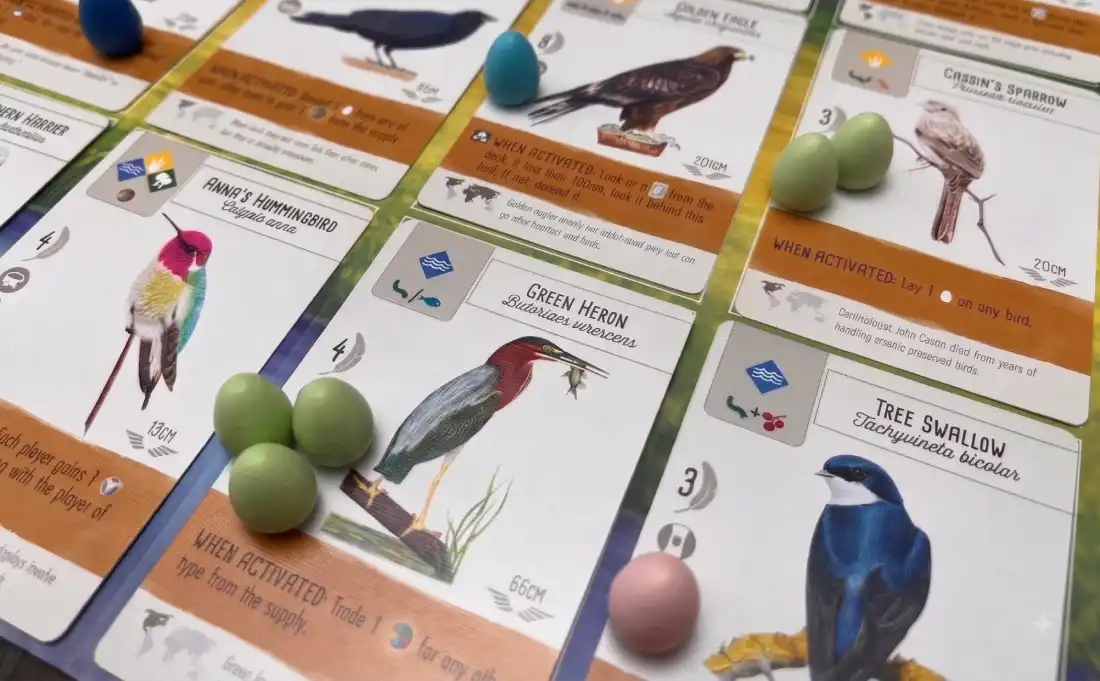
At a glance
- Players
- 1-4
- Play Time
- 60 min
- Ages
- 10+
✓ What We Love
- •The art by Elizabeth Hargrave is amazing, you also can learn cool fun facts about birds in the cards
- •There are many ways to win and surprise your adversaries
- •I love the tiny colored eggs
✗ Could Be Better
- •You really need to stay focused so you can see what your rivals are doing
- •Not a game for chitchat
- •Could you really win by just collecting eggs?
- •No for beginners, it can be overwhelming to understand it all
About Wingspan Board Game Review
Most reviews stop at how the artwork looks, treating genuinely well-made pieces and a tense game like wallpaper, which is why a fuller, balanced take is worth your time first.
This review starts somewhere less flattering: eleven turns into my first game, I had a plan. A red-shouldered hawk on my tableau let me discard a card to draw two others whenever I played a bird, feeding a nest full of raptors I’d been slowly collecting.
I placed my cube for the draw, expecting something useful, going in confident. The tray coughed up a chickadee, a heron, and a duck. Nothing that fed the plan. I drew blind from the deck instead and got a card that didn’t fit either. That was the moment I understood what this game actually is underneath the birdsong and the watercolor art: a machine that hands you fewer and fewer tools to keep your birds fed, and never once offers a way to force better luck.
That’s the part the “relaxing bird game” reputation leaves out. Wingspan hands you eight cubes in round one and takes one away every round after, so by the end you’re making five decisions where you used to make eight, and your tableau has gotten expensive to run in the meantime. I love how unforgiving the math gets once you’re a few turns in. Every bird beyond the first in a row costs an egg on top of its usual price, which sounds like a minor detail until you’re staring at an empty egg supply with three grassland birds you can’t afford to place.
The best decision most rounds is the one you can’t afford to make. None of this is explained as a threat in the rulebook. It just quietly closes in on you, a little more each time, while the birds on the table keep looking prettier.
This is fundamentally about building, not luck; every choice strengthens or stalls what you’re building. That tension is also the answer to whether it’s fun, not just pretty. It is. But it’s fun the way a tight logistics puzzle is fun, not the way a chaotic party game is fun, and that distinction matters more than the box art suggests.
Solo, Two-Player, and the Full Table
Wingspan scales from one to five, and it holds up better across that range than most tableau games manage. Solo play runs against Automa, an AI opponent driven by its own bird deck, introduced with the Oceania expansion, and it’s a legitimate way to learn the engine before facing humans, not a watered-down afterthought. I still love watching new players hit that same wall I did. With two, the game tightens rather than loosens, since there’s less competition for the face-up bird tray, which ironically softens the “no way to refresh your options” problem. What playing at five feels like differs from playing at two. At four or five, competition for the cards gets real, and the birds you were counting on will occasionally vanish before you get to them. If you’re new to hobby games entirely, Wingspan is at its best in the middle of the table range, and it still scales down to a great, welcoming teach for someone new to rules explanations; if you’ve been doing this a while, the tightest, most interesting version of Wingspan is closer to two or three than a full table. It’s a great way in, and the challenge only sharpens from there.
The Expansions: What’s Actually Worth Adding
Stonemaier has released three expansions, and they’re not interchangeable. The European Expansion (2019) is the most conservative of the 3, more birds and more bonus cards in the same shape as the base, a safe pickup for more variety without changing how the game feels. Oceania (2020) is the one that matters most, since it introduced Automa for solo and cooperative play, plus a “duet” mode built specifically for two. If you’re only adding one expansion, it’s this one. Asia (2022) is built around a ruleset focused on two, raising tension between opponents instead of softening it, for people who already find the base too polite. None of the 3 are required to enjoy the core experience, just you and your birds. Wingspan’s expansions are worth it in that order, not as a package deal.
If Everdell or Lost Ruins of Arnak are familiar, and you liked the feeling of a tableau slowly clicking into place, Wingspan sits comfortably in that same family, just with a cleaner, more mathematical spine, closer to genre standards than most newer titles. It’s a good entry point into that whole strategy genre, and for a lot of people it’s the one that gets them hooked on the rest of it. Here’s the mechanical engine underneath all of that, the part most reviews skip, and the part this review actually cares about, written to hold up whether you’re new to the table or years into it.
📖 Rulebook
How to Play Wingspan
Setup
- Shuffle the bird deck and place 3 cards face-up in the bird tray.
- Put all nourishment tokens and egg miniatures into the shared supply.
- Toss all five custom dice into the birdfeeder tower.
- Choose which side of the goal board to use, the green side for a more competitive point spread, the blue side for a gentler, points-per-item version recommended for new players.
- Shuffle the goal tiles and place one on each of the four blank spaces.
- Give each player a mat, 8 action cubes, 2 bonus cards, 5 birds, and 5 food tokens.
- Each player keeps up to 5 of their starting birds, discarding one food token for every card kept beyond the first, going light early.
- Keep 1 of your 2 starting cards and discard the other.
- Randomly choose who goes first.
Your Turn
On your turn, place one cube to take one of four actions:
- Play a bird. Choose one from your hand, pay its nourishment and egg cost, and place it in the appropriate row, forest, grassland, or wetland, in the next open slot. If it has a pink "when played" power, resolve it now.
- Gain food. Place your cube on the leftmost open space in the forest row, then move it right to left, activating any brown "when activated" abilities belonging to birds already there, gaining whatever's shown on the space where the cube stops.
- Lay eggs. Same process, but in the grassland row, gaining eggs instead.
- Draw birds. Same process again, but in the wetland row, drawing from either the face-up tray or the top of the deck.
Habitat Powers and Activation Order
Whenever you take the nourishment, egg, or card action, you don't just get the resource, you also activate every brown "when activated" power belonging to birds already in that row, in order from right to left, before your cube comes to rest on the leftmost open space. Each of those powers is optional. This is the part new players misplay most often, either forgetting to trigger earlier birds in the row or activating them in the wrong order, which changes what's available for the birds triggered afterward.
End-of-Round Goals
At the end of each round, players score against the goal tile using whichever side of the goal board was chosen at setup. On the green side, players rank 1st through 5th based on who has the most of the targeted item, splitting points evenly (rounded down) in the case of ties, and you need at least one qualifying item to score at all. On the blue side, everyone scores 1 point per qualifying item, up to a maximum of 5. Mark your placement with an action cube, then retrieve your remaining cubes, refill the bird tray, and move on.
Winning
Wingspan runs exactly four rounds, with players getting 8, 7, 6, and 5 actions respectively as they progress. At the end, add up points from the birds on your tableau, your bonus cards, your four end-of-round goal scores, and 1 point each for every egg, cached token, and tucked card on your birds. Highest total wins. Ties are broken first by whoever has more unused tokens in personal supply, and any remaining tie is a shared win.
📖 Rulebook
Components: Goal board, scorepad, 40 wooden cubes, 170 birds, 103 food tokens, bird tray, 26 bonus cards, 8 goal tiles, 5 player mats, 75 egg miniatures, first player token, birdfeeder tower, 5 custom dice, rulebook and appendix.
Setup order matters: food and egg tokens go into the shared supply before the tower is loaded; the goal board side is chosen before goal tiles are placed, since it determines how many tiles you need and how they're read.
Habitat actions always follow the same 3 steps: place the cube on the leftmost open space in the row, slide it right to left while resolving any brown powers along the way, then leave it on the space where it stops.
Bird power types: pink powers trigger once, immediately, the moment a bird lands. Brown abilities trigger every time that habitat's action is taken, for as long as the bird is in play. White powers trigger when someone else takes a specific action, not during yours.
Egg costs: the first feathered creature placed in each habitat costs food only; every bird after the first there also costs eggs, with the cost increasing as the row fills.
Scoring at game end: point values on your flying creatures, plus your other cards' totals, all four end-of-round goal scores, plus 1 point each for eggs, cached tokens, and tucked cards. Tiebreaker is total unused tokens in supply.
Edge case: if the deck of avians runs out during a draw, reshuffle the discard pile (if the game is using one) or treat the remaining draw as unavailable per that printing's rulebook errata, since printings vary slightly.