Loading…
Candy Land
The game every hobbyist loves to hate. No toddler has ever noticed.
2.8
(0 reviews)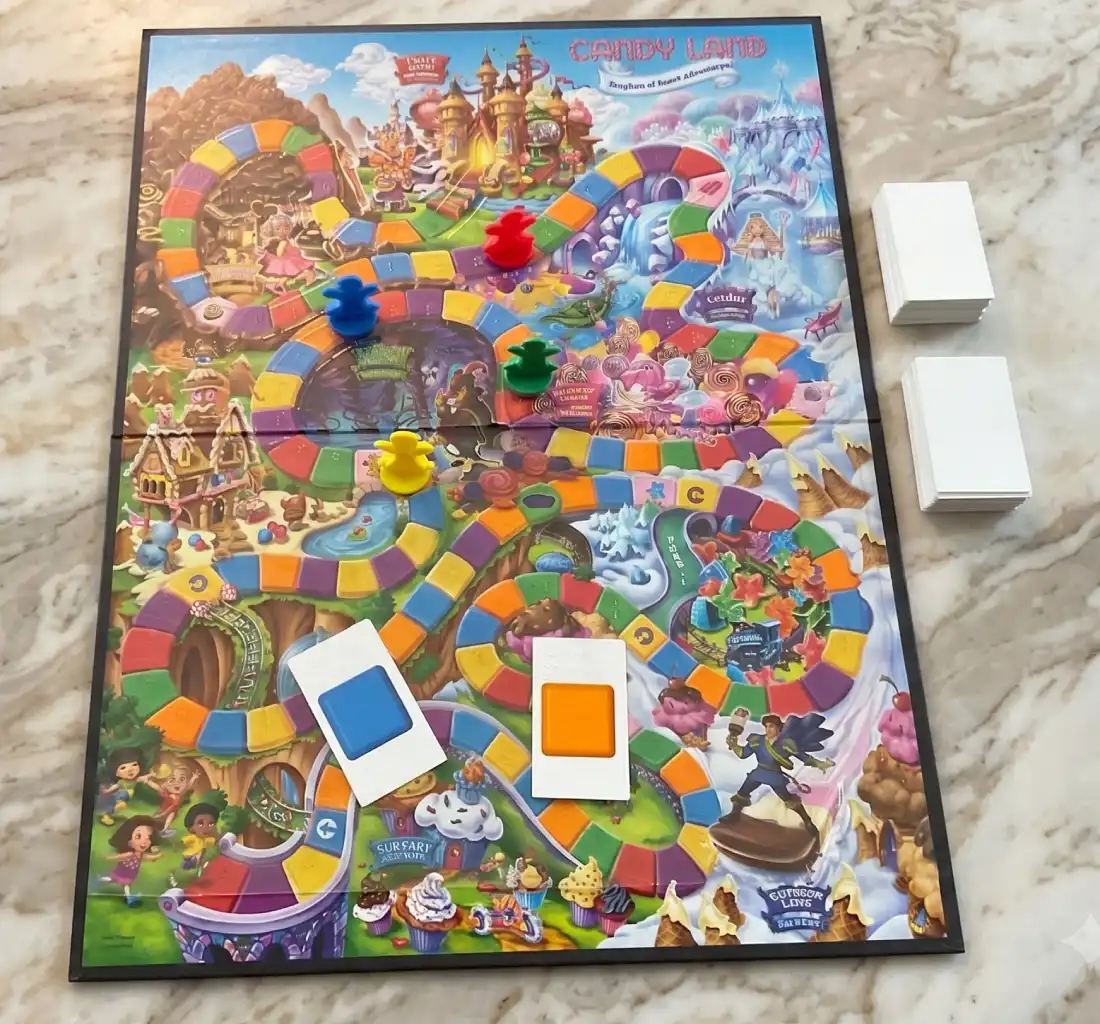
At a glance
- Players
- 2-4
- Play Time
- 20-30 min
- Ages
- 3+
✓ What We Love
- •Zero reading, the kid literally just needs to pick a card and follow a color
- •Great way for kids to learn colors
- •Bright colors, nice characters
- •Durable, anyone can teach it
✗ Could Be Better
- •No real decisions at any point in the game, the winner is fixed the moment the deck gets shuffled
- •Those lovely cards that take you back to the beginning, real life lesson for kids
- •It can get boring if you are a parent but kids love it
About Candy Land
Why Candy Land Feels Like a Coin Flip With Scenery
Draw a card, move to the matching color, repeat until someone reaches Home. That’s the entire game, two words on the box even though everyone just says Candyland. Sid Meier’s old definition of a game as a series of interesting choices is the usual yardstick hobbyists reach for, and Candy Land fails it outright. You never choose anything except whether to keep playing. The outcome exists the moment the deck finishes shuffling. Everything after that is theater.
I don’t disagree with that read. I disagree with stopping there, because it treats a design constraint like a design failure.
Watch a kid play it and the coin flip framing only tells half the story, because not every draw lands the same. Here’s what happens once you’ve sat through enough rounds to watch the reactions.
| What You Draw or Land On | What Happens | How Kids Actually React |
|---|---|---|
| Land exactly on Mountain Pass or Rainbow Trail | Skip straight to the other end of the shortcut | Delighted screaming, the best moment in the whole game for most kids |
| Picture card (forward) | Jump straight to that landmark, however far ahead it sits | Genuine excitement, they’ll want to look at the picture twice |
| Double-colored card | Skip ahead to the second matching space | A small, satisfied grin |
| Single-colored card | Move to the next matching space | Total non-event, they move the piece and move on |
| Land on Cherry Pitfalls or Molasses Swamp | Stuck until you draw a card matching that space’s color | An audible groan, but recoverable |
| Picture card (backward), the one most kids know as Plumpy | Sent straight back to that landmark, no matter how far you’d already come | This is the one that actually produces tears |
The Origin Story Nobody Leads With
Eleanor Abbott, a retired schoolteacher, designed Candy Land in 1948 while a patient in a San Diego hospital, sick with polio herself and surrounded by children fighting the same illness. Some of those kids couldn’t read yet. Some couldn’t sit upright long enough to hold a hand of cards.
She built a fantasy path from Start to Home through a candy-covered countryside, Gumdrop Mountains, Peppermint Stick Forests, Ice Cream Float Seas, naming every stop after something a hospitalized kid would rather be dreaming about. The following year she submitted it to Milton Bradley, whose business at the time was mostly school supplies, and their small but growing games division decided to take a chance on it. It became a bestseller almost immediately.
The colorful gingerbread movers everyone associates with the game now weren’t even part of the original release, Milton Bradley added those once it was clear the thing had staying power. Abbott, for her part, gave a large share of her royalties back to buy school supplies and equipment for the hospital kids who inspired it. It sold well enough for decades that Hasbro eventually had to go to court just to pry the candyland.com domain away from an adult website that had registered it first, a genuinely strange footnote for a toddler’s board game.
Every complaint leveled at Candy Land today, the lack of choices, the fixed outcome, the total absence of reading or counting, was the actual brief. Abbott wasn’t trying and failing to build a strategy game. She built a machine for letting a sick three-year-old feel like they were playing something, win or lose, without needing to understand odds, letters, or numbers.
Judged against that brief, it’s a precise piece of design. Its true peer group was never a hobby strategy game, it’s Monopoly, Operation, and Guess Who, the other classics generations of kids have genuinely loved despite real design problems of their own. Monopoly runs twice as long as anyone wants and lets one lucky property trade decide the whole night. Operation doesn’t have a single decision in it either, just a steady hand and a buzzer. Guess Who works because kids like winning a deduction game, not because the deduction in it is any good. Nobody’s spent a decade arguing about whether any of those three count as games at all. Candy Land just drew the short straw.
The Real Fight Isn’t About This Game At All
This is where the hobby’s own standard falls apart. Board Game Geek won’t catalog a jigsaw puzzle as a game, because there’s no decision structure and no way to lose.
It will happily catalog Candy Land, which offers exactly as little agency as a puzzle does. If “does it involve interesting choices” were really the standard being enforced, Candy Land and War would have been dropped from the database decades ago along with every other zero-agency product. They weren’t, because the standard isn’t really being applied to Candy Land. It’s being applied to something else.
What “that’s basically Candy Land” really means is an insult aimed at other adult games. It gets thrown at $70 Kickstarter releases that dress up a random-outcome engine in enough theme and cardboard to hide how few real decisions you’re making until three plays in.
Candy Land is the easy stand-in because it can’t argue back and nobody feels bad calling a toddler’s game thin. The argument was never really about Candy Land. It’s a proxy fight the hobby has with itself about which of its own adult products are getting away with the same trick on purpose.
The rules themselves aren’t innocent here either. For fifty-five years, whether you had to land exactly on the final square to win, or just draw a card that carried you past it, was a genuine unresolved argument, and that square used to be violet.
Hasbro didn’t settle it until 2004, when the mainline edition swapped that violet square for a rainbow one specifically to kill the debate for good. I spent my entire childhood chasing that purple square and losing anyway, which tracks for a game whose own publisher couldn’t agree for five decades on how it ended.
Is Candy Land Worth Buying in 2026?
This lands at a 3.0 because it does exactly what it was built to do, and nothing past that. Zero agency is zero agency, no amount of nostalgia changes the math once you’re grading it by today’s standards. But that same nostalgia is exactly why it’s still worth keeping in the closet. Sometimes the point isn’t optimal design, it’s a candy-colored path a kid already loves before you’ve explained a single rule. Want it to feel more like an actual game for older kids or bored adults on hosting duty? Deal two cards a turn and let the player choose which to play. Costs nothing, gives everyone one real decision. Once a kid’s ready for a real decision every turn instead of zero, Bears vs Babies is the natural next step off this shelf.
The Cards Everyone Actually Remembers
Cherry Pitfalls and Molasses Swamp are the two spaces that do the real damage, and they’re the reason this game has a reputation it never quite shakes. Try explaining to a four-year-old why their lead just evaporated two spaces from Home because of a card they didn’t choose to draw.
That’s actually the most refreshing thing about this game, though. Most kids’ activities get engineered to soften every edge, no real losing, everybody gets a trophy. Candy Land doesn’t bother. You get stuck on a space you didn’t pick, for a reason you can’t argue with, and you sit there hoping for the right color turn after turn. That’s not a flaw a parent needs to apologize for, it’s closer to a kid’s first real lesson that luck doesn’t care how badly they wanted to win.
My table still plays the pre-2006 version of these spaces, stuck until the matching color actually comes up, not the flattened one-turn penalty most editions switched to that year. Watching a kid’s face while they hope for one specific color card is a better moment than this game gets credit for. Doesn’t make the meltdown any shorter when it doesn’t come up, though. Budget for one.
Bringing Plumpy Back
Depending which box you own, you may never meet Plumpy at all. The classic reissue that hews closest to Abbott’s original design doesn’t name its picture cards, the rulebook just gestures at “the Gingerbread Cookie, etc.” and leaves it there, a small but real gap in an otherwise clear manual.
Plumpy belongs to Hasbro’s separate, narrative-driven mainline edition, where he was the plum-shaped card that sent you sliding backward for decades before getting quietly written out around 2002 in favor of a character called Mama Gingertree, no explanation given.
He sat out for over twenty years before the most recent relaunch brought him back with an actual biography: last surviving member of a species called the Plumpa Trolls, caretaker of the Gingerbread Plum Trees, prone to stress eating after the king gets kidnapped. Two different publishers’ worth of Candy Land, and one of them now has more expanded-universe lore than half the strategy titles on my shelf, in a game where nobody makes a single decision.
Gramma Nutt, the peanut-obsessed grandmother from that same cast, left enough of a mark on me that I still do a double take at strangers on the street who look like her, which says more about how deep this game’s world burrowed into my brain as a kid than any strategy game ever has.
People keep grading Candy Land against a rubric it was never built to pass, and get strangely worked up about the results either way. It was built for a kid in a hospital bed in 1948 who needed a turn to take. It still does that job. It just isn’t, and was never supposed to be, a game for people like us, and it’s exactly why it still earns its spot in our kids category instead of anywhere near the strategy shelf.
📖 Rulebook
How to Play Candy Land
Setup
- Unfold the board and place it where every player can see the winding path from Start to Home.
- Shuffle the deck of color and picture cards, then place it face down within easy reach of everyone.
- Give each player a differently colored pawn and set it on the Start arrow.
- Youngest player goes first, it's an actual printed rule, not just table etiquette.
- Everyone travels in the direction the path's mileage signs point.
Your Turn
- Draw the top card from the deck.
- If it shows a single colored square, move your pawn forward to the next space matching that color.
- If it shows two colored squares, move forward to the second matching space, skipping the first.
- If it shows a picture, move your pawn straight to that matching space on the board, ahead or behind, the one break from normal forward movement. You continue from there on your next turn.
- More than one pawn can occupy the same space, nobody gets blocked.
- If the deck runs out before anyone reaches Home, reshuffle it and keep going.
- Play passes to the next player.
Shortcuts and Setbacks
Land exactly on the space marking the start of the Mountain Pass or the Rainbow Trail and you jump straight to the other end of that shortcut, continuing from there next turn. Overshoot it by a single space and you get nothing, which is exactly the kind of small cruelty that makes this game more tense at a kids' table than its reputation suggests. The board also enforces its own penalties at the Cherry Pitfalls and the Molasses Swamp, follow whatever instructions are printed on those spaces when you land there. None of it comes with character names or backstory, that flourish belongs to other editions.
Winning
Home is the last blue space on the path. The first player to land on it, or to draw a card that would carry them past it, wins immediately. No exact count is required and there's no scoring beyond being first through the door.
Rulebook
Components: Game board with a Start arrow and a Home space, 4 differently colored pawns, deck of single-color, double-color, and picture cards.
Setup: Shuffle the deck and set it face down within reach of everyone. Every player starts on the Start arrow. Youngest player goes first.
Turn phases: Draw one card. Move according to what it shows. Pass the turn.
Special cards: A single colored square moves you to the next matching space. Two colored squares move you to the second matching space, skipping the first. A picture card moves you directly to its matching space anywhere on the board, forward or back, the only break from normal forward movement.
Board features: Landing exactly on the start of the Mountain Pass or Rainbow Trail sends you straight to the other end of that shortcut. Cherry Pitfalls and Molasses Swamp carry their own printed penalties, follow the board.
Edge cases: Two or more pawns can occupy the same space, nobody gets blocked. If the deck empties before anyone reaches Home, reshuffle it and keep playing.
Winning: First player to land on the last blue space, or to draw a card that would carry them past it, wins outright.