In this article
Four homemade Wingspan bird cards while we wait for Africa
Here’s a fact that made me feel a little better about my own impatience: when Stonemaier Games asked its newsletter subscribers to vote on Wingspan’s next expansion after Americas, the result was an exact 50/50 split between Africa and the Arctic. Not close. Tied.
Co-founder Jamey Stegmaier confirmed it himself in the comments of the studio’s 2026 lineup announcement, and as of that announcement, neither one had a release date attached.
So somewhere out there is a spreadsheet with a coin sitting on it, and an entire continent’s worth of hornbills, rollers, and one deeply unfair flightless bird is stuck in limbo because a newsletter audience couldn’t commit.
I wasn’t going to just sit around. Wingspan’s card design is more formulaic than people give it credit for, once you’ve actually pulled apart what a hundred and seventy real cards do. Food cost tracks roughly with point value. Egg capacity tracks with nest type and body size. Power color tells you when in the turn structure a bird is supposed to matter. Once you know the pattern, you can build a card that would slot into the real deck without anyone flagging it as fan-made from the stats alone.
So that’s what I did. Four birds, four habitats, calibrated against real cards already in the box. Not concept art, not vague “wouldn’t it be cool if.” Actual stat blocks.
The Secretary Bird Walks Its Prey to Death
Most raptors in Wingspan hunt the way you’d expect a raptor to: from the air, from a perch, with talons. The Secretary Bird doesn’t. It’s a four-foot-tall grassland predator that hunts almost entirely on foot, and it kills snakes by stomping them, repeatedly, with enough force to break a spine. It looks like someone crossed an eagle with a heron and then gave it the temperament of a bouncer.
| Points | Nest | Egg cap | Wingspan | Habitat | Predator |
|---|---|---|---|---|---|
| 7 | Platform | 1 | 210 cm | Grassland | Yes |
Cost: Rodent, Rodent, Invertebrate Brown, When Activated: Roll all dice not in the birdfeeder. Gain 1 food for each one showing invertebrate or rodent.
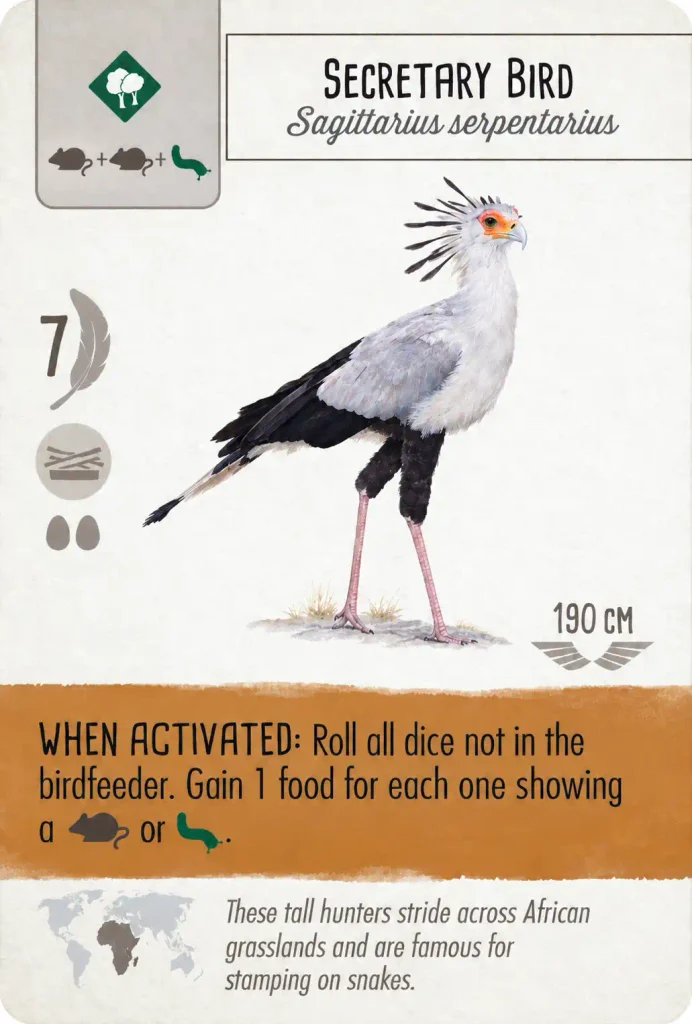
I built this one off Golden Eagle, which is an 8-point platform predator with a heavy rodent cost and a card-tuck power. The Secretary Bird trades that gamble for a flatter, more reliable dice payout, which is why it sits a point lower. It’s not the flashiest bird in this set. It’s just honest about what it does, which is more than I can say for half the raptors already in the base game.
The Shoebill Is Built Like a Nightmare and Hunts Like One
The Shoebill stands stock-still in a swamp for hours, sometimes most of a day, waiting. Then it strikes fast enough to take down lungfish, eels, and on occasion a baby crocodile. It has a beak shaped like a Dutch clog and eyes that don’t blink so much as judge you. If any bird deserved to headline a wetland-heavy expansion, it’s this one.
| Points | Nest | Egg cap | Wingspan | Habitat | Predator |
|---|---|---|---|---|---|
| 8 | Platform | 2 | 230 cm | Wetland | Yes |
Cost: Fish, Fish, Rodent Brown, When Activated: Gain 1 fish from the supply. If you do, tuck a card from the deck behind this bird.
Bald Eagle is the obvious comparison here: 9 points, platform nest, a fish-and-rodent cost, one flat gain-all-the-fish power.
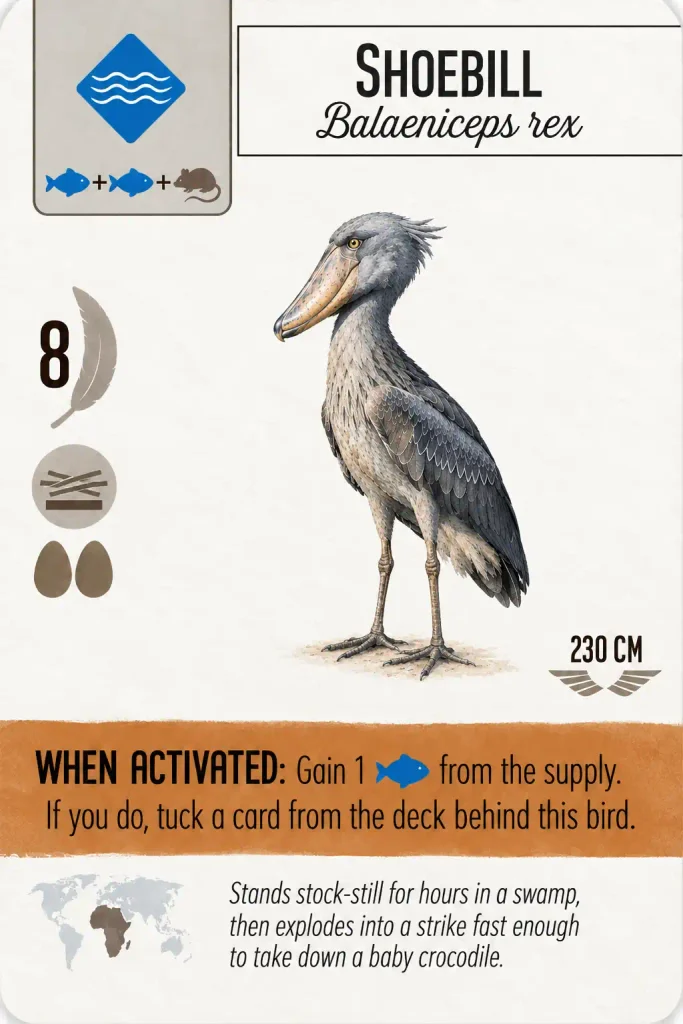
The Shoebill’s power does two things at once, food and card advantage in a single activation, so it costs a point to keep it from just being a strictly better eagle. That’s the part people miss when they design fan cards. A cool animal doesn’t automatically earn a cool power. Sometimes the honest move is docking a point so the math still works.
The Ostrich Is Just Really, Really Good at Laying Eggs
The Ostrich is the largest living bird, it can’t fly, and it lays the biggest egg of any bird on the planet, sometimes over three pounds. Females also share communal nests, dumping their eggs into one dominant hen’s clutch until a single nest holds dozens of eggs from multiple mothers. It’s less a bird and more an entire egg-laying operation with legs.
| Points | Nest | Egg cap | Wingspan | Habitat | Predator |
|---|---|---|---|---|---|
| 9 | Ground | 6 | 200 cm | Grassland | No |
Cost: Seed, Seed, Fruit Pink, When another player takes the lay eggs action: This bird lays 1 additional egg on itself, if it has room.
An egg capacity of 6 would be the highest number in the base game, and I did that on purpose. This card isn’t clever. It doesn’t need to be.
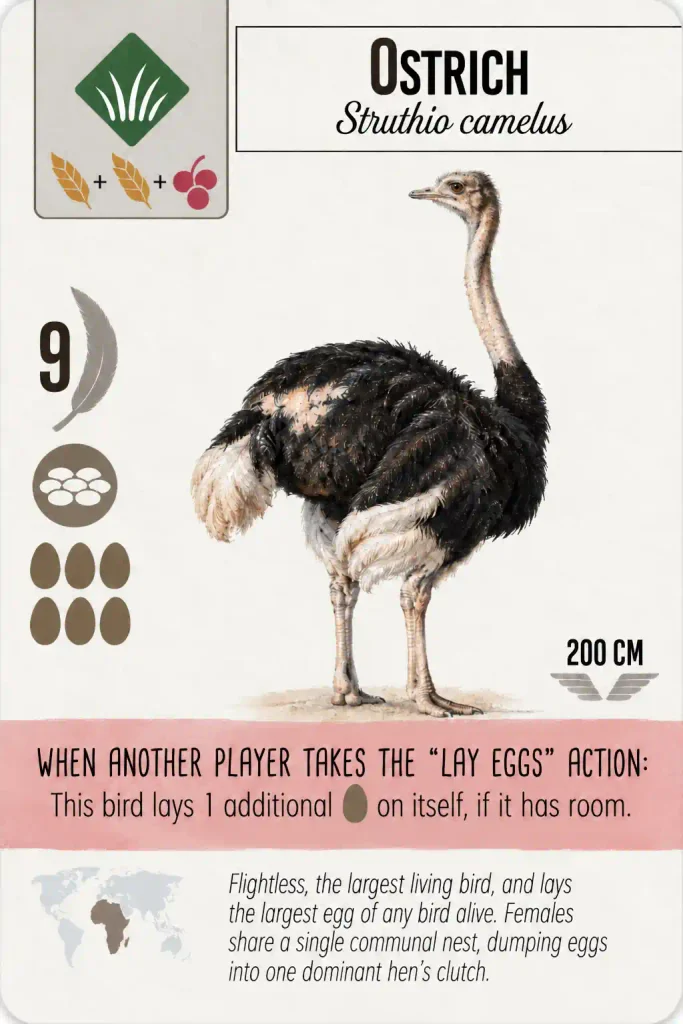
The joke is baked into the stat line: everyone else’s birds lay eggs on their turn, this one lays eggs on everyone’s turn, because that’s genuinely what the species does in the wild. Wild Turkey is the closest existing comparison at 8 points and an egg cap of 5, and the Ostrich edges past it for the same reason it edges past every other ground nester in real life. It’s just built different.
The Lilac-Breasted Roller Is Almost Too Colorful to Be Real
Kenya’s national bird gets its name from the tumbling, rolling display flight males perform to show off, and once you’ve seen the actual color combination, blue, green, lilac, and rust in stripes across one small body, you understand why. It’s the bird nobody believes is real until they’ve seen a photo.
| Points | Nest | Egg cap | Wingspan | Habitat | Predator |
|---|---|---|---|---|---|
| 4 | Cavity | 3 | 54 cm | Forest, Grassland | No |
Cost: Invertebrate Brown, When Activated: Roll all dice not in the birdfeeder. Gain 1 invertebrate for each one showing invertebrate.
This is the filler card of the set, and I mean that as a compliment. Every real Wingspan deck needs cheap, low-commitment birds that keep a turn moving without demanding a strategy built around them.
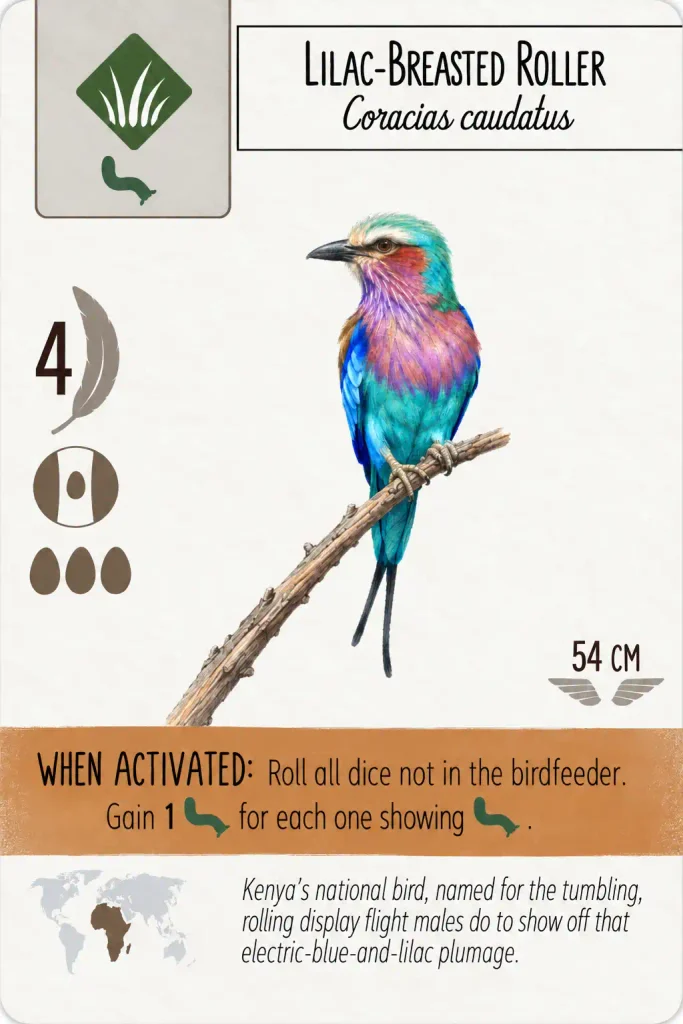
Anhinga runs a similar dice mechanic in the actual game, just scaled up for a bigger bird with a bigger nest. The Roller is what that mechanic looks like shrunk down to a one-cost forest bird nobody’s going to build a whole engine around, and every good deck needs a few of those.
Where This Actually Goes
None of this is official, and Stonemaier hasn’t said a word about which continent wins the coin flip that never happened. But the fan community has been trading wish lists for years now, and the appetite for African species specifically, not just “more birds,” is loud enough that it’s clearly not going away.
If the real expansion ever ships, I’d bet money at least one of these four species makes the cut. The Secretary Bird and the Ostrich in particular feel less like predictions and more like inevitabilities. Until then, these four live here.
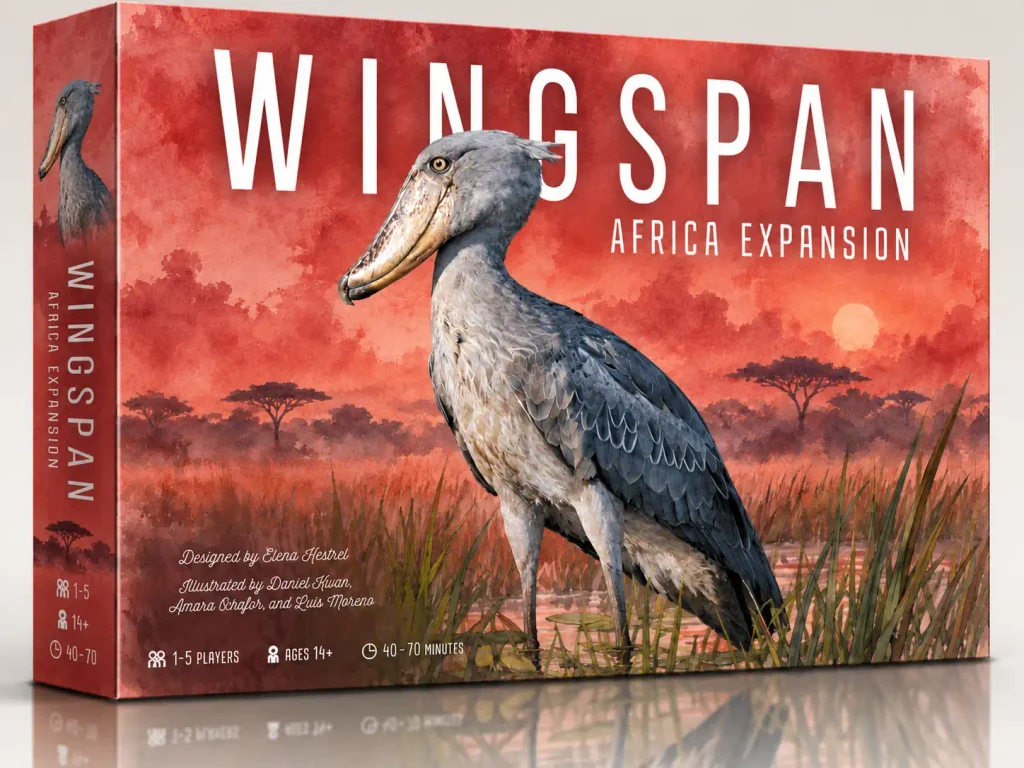
Just in case, we also created the box, consider it a little push to make this happen.